


Can you tell us the story behind your photo in this exhibition?
My main subjects in nature are insects, plants and the landscapes in which they live. As a close-up photographer, I am constantly aware of what is going on beneath my feet but at the same time I am also conscious of the backdrop to these macro scenes such as the landscape and the sky. This stops me from becoming too myopic!
Sometimes I set out with a specific subject in mind, and this certainly applies to the project which has preoccupied me throughout the spring and summer of 2017. At other times I simply keep my eyes open for opportunities that might present themselves.
How did you go about getting that shot?
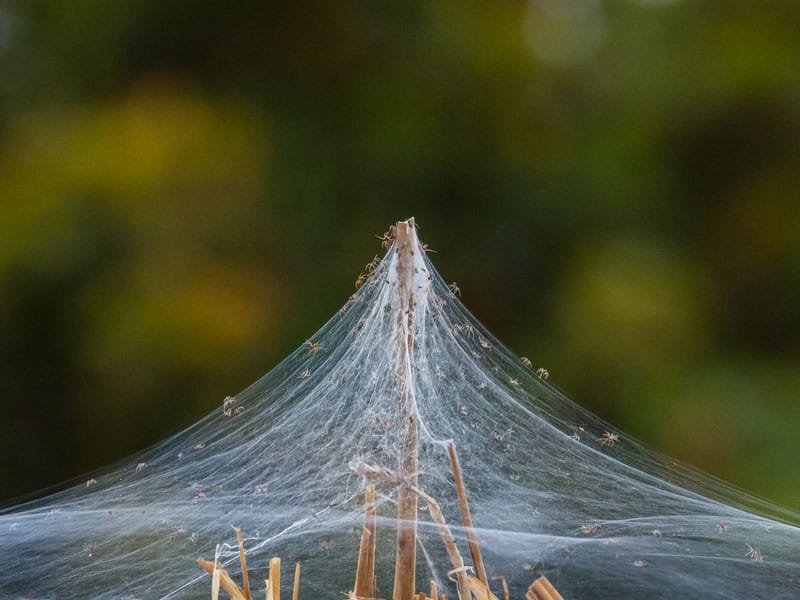
The spider shot was one such opportunity. For several days in succession I had noticed a steady build-up of gossamer tents on, of all things, a large dung-heap in the corner of a field. The autumn sky is full of countless tiny spiderlings ballooning through the air at the end of silken threads, driven by an impulse to disperse. The warm, cosy environment of the dung-heap evidently encouraged these migrants to stay on!
How long did you have to wait for this shot?
A few preliminary shots failed to bring out any sense of drama in the shape of the tents themselves. What was missing was dramatic lighting. This meant waiting for a low sun to provide back-lighting. I had already identified one or two individual tents with interesting symmetrical shapes but it was several evenings later that the sunset supplied the missing element.
Did you use any particular equipment or software?
To diffuse the background I used a medium telephoto lens rather than a conventional macro lens. Time and environment precluded the use of a tripod so the shot had to be done hand-held. This forced me to use a relatively high ISO number, which is always a negative in macro work, but also a narrow aperture which was a plus because (as bird photographers know) it provided the “bokeh”. Photography like everything else is a compromise.
What are your favourite scenes, species or motivations behind your photographs?
It is not always easy to describe the motivations behind one’s photography, indeed it might be counter-productive to try to analyse this too closely. I speak as a nature photographer trying to capture something indefinable in my subject although of course certain boxes, technical in nature, always have to be ticked. My motivation is ultimately to be found in the opening statements above: a wish to present my close-up subjects, not as isolated things seen through the end of a lens, but as creatures inhabiting a landscape. Hence my attempts over the years to develop the vision and the equipment to make this happen.
What are the difficulties of wildlife and nature photography that you face?
This brings us to difficulties of nature photography. In my own case there are two kinds of difficulty. The first is technical and I could write a book describing the way in which I have tried to match aspiration to technical innovation. Perhaps at a later point. But equally, success has meant trying to understand the behaviour of the beast. In my latest work I photograph insects in flight, with a hand-held camera. The technical problems are considerable but the biggest challenge has been trying to predict the behaviour of the insect in the next half-second of time. That half-second is my only window to getting a shot. If I say it is a battle of wills (the insect’s and mine) that might sound like over-statement, but is nothing less and nothing less gets the shot.
What would you like people to think about when they see your work?
The beauty of nature and this applies particularly to the more conventional macro work. Macro work is rarely going to have the emotional impact that, for example, a photograph of a tiger or a shark might have because people cannot project their emotions onto a beetle. But in my “panoramic lose-up photography,” I do ask the viewer to don a different pair of spectacles, to see the insect or flower in the larger landscape. Almost as if they were momentarily shrunken in size and standing next to it.
Does this bring the viewer closer to nature? It will never be possible to empathize with a butterfly but I do believe a “close-up within a landscape” shot can instil the feeling that tiny creatures such insects live out their lives “alongside” us humans and share the same space, rather than existing remotely beneath our feet.
How long have you been a photographer and how did you get started?
Since about 1987. I was on a springtime visit to the Mediterranean island of Rhodes. I was entranced by the colours of the mountainsides but realized on returning home that I had only mental images where photographs might have done a better job. Never an advocate previously, I now picked up a camera and began an adventure.
What would you advise someone wanting to start taking photos of wildlife or nature in their local environment?
To anyone wishing to take up nature photography I would say, forget the camera for a few weeks, go out into the countryside and use your eyes. Take mental pictures if you wish but remember that the camera is only the hand-maiden of the eye. In that period you may well come home and say to yourself regretfully “wish I had had the camera, I missed that wonderful shot!”. Good, you are on the right road, so go out and buy a camera and don’t worry, the best one always got away. If you do not, you need more practice with your eyes.
What projects are you working on now or have coming up?
Autumn has just brought my present project to a close since the insect season is now over, for a few months at least.