Tell us the story behind your photo in this exhibition.
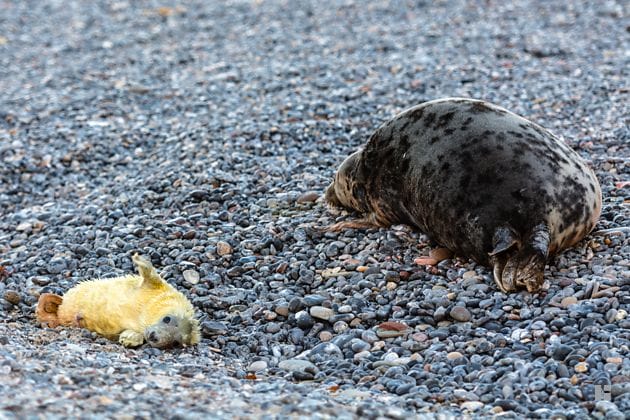
It was winter on Dune, a small island in the North Sea. Grey seals (Halichoerus grypus) give birth on Dune during November – January. The number of pups born on Dune has increased dramatically from around six in 2001/2002 to 316 during last winter.
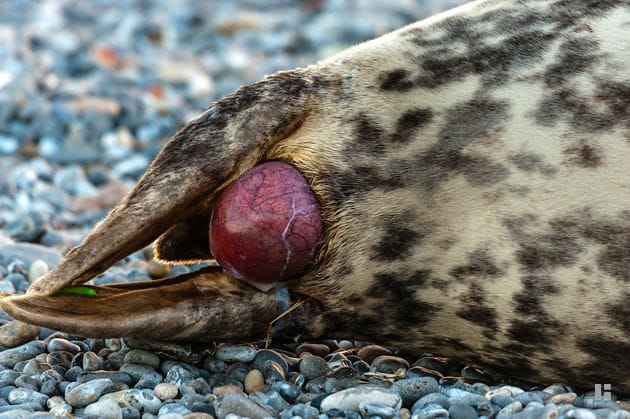
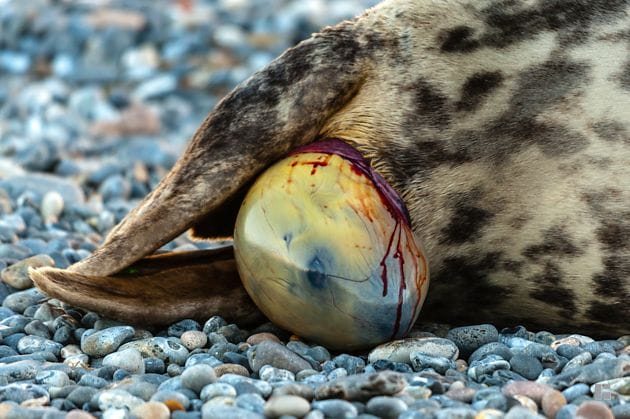
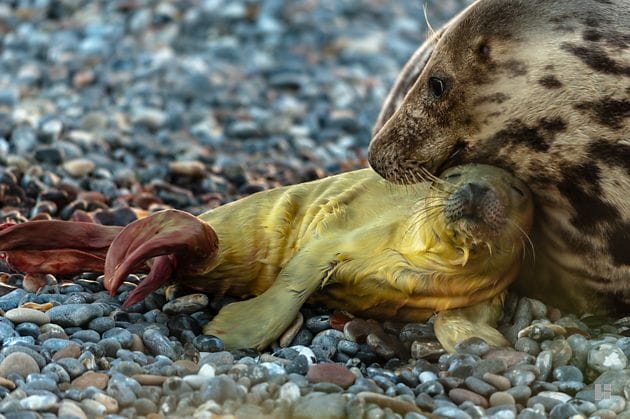
Despite the increased frequency of births, to actually observe one during daytime is very rare. Emotions are very high and the experience is beyond words. The pup shown in this photograph is still in its amniotic sac but has opened its eyes already. The first shapes it sees belong to good-willing humans – nature observers and nature photographers – all people who are well-disposed towards it and grey seals overall.
The coexistence of humans and grey seals works very well on the Dune. Tolerance and respect towards the ‘largest German predator’ is key. Hopefully it will stay like this in the future.
How did you go about getting that shot?
Dune is an island just close to Heligoland, where one cannot stay overnight during winter. Therefore you need to catch the first ferry at 8am (before sunrise) and you don’t want to miss the last ferry at 4pm (before sunset).
During the day I normally roam the beaches of the small island taking into account restrictions based upon tide, weather and grey seal occurrence and location (you are asked to maintain a 30m distance although not all seals obey the rule).
In order to photograph a birth you need to be there at the right time – a trivial request, but not easily fulfilled. First you need to identify a pregnant cow ready to deliver. Once the female decides on a nice birth-place, it will take two – three days until she gives birth.
You need to observe those closely and decide where to spend your time waiting. Even with my experience of a couple of winters it is not a sure guess.
Secondly, you need to see whether you can approach without disturbing her. There are large differences in the tolerances of the pregnant females to accept neighbours – not only for humans but towards other grey seals as well. Usually, you want to avoid placing yourself between the cow and the water. In any case I use a long lens to minimise impact, as a longer distance means it is not as disturbing to the seal if I change position.
In this particular case we observed the mother-to-be already on the second day. At 11am we thought it was going to happen soon, but it actually took place at 3pm. This particular mother was very tolerant towards us, she even moved during the whole process to get closer to our small group of observers.
Did you use any particular equipment?
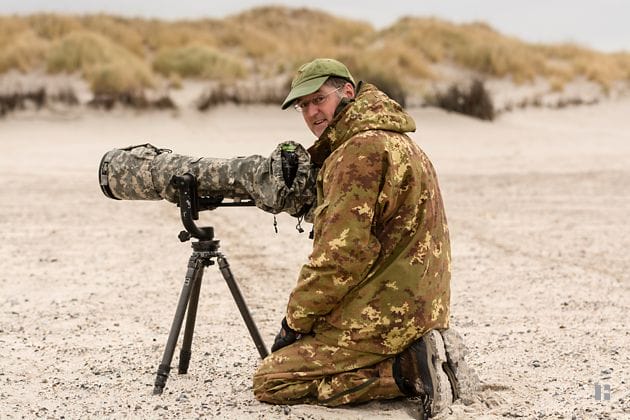
Long lens: Sigma 300-800mm f/5.6 at 800mm on a Nikon D700 (full-frame), tripod. I strongly recommend using long lenses even if one could come closer to get the picture, it simply minimises the impact on the subject. Although wide-angle images certainly appeal to many, I would only tackle those remotely controlled for the grey seals.
What would you like people to think about when they see your work?
I would like them to think it is a great image (one that is aesthetically pleasing and creates interest). I would like them to ask ‘what does it show?’ and to try and understand what it is about. It would be great to create a connection with their own knowledge and experience and get people thinking about what they can do to preserve the nature shown in the image.
How long have you been a photographer and how did you get started in your career?
I am taking nature photography ‘seriously’ since 2004 when I made my first visit to Lunga (Treshnish Isles, Scotland) together with the first use of a digital SLR. Nowadays I call myself a part-time nature photographer.
What would you advise someone wanting to start taking photos of wildlife in their local environment?
Get a camera you like to operate, get into contact with local nature conservation organisations to learn about locations and wildlife opportunities to be seen where and when and start by ‘recording’ nature to get a feel for it and becoming more able to decide where to concentrate upon.
What are your favourite scenes to photograph?
I like to observe and photograph animals without the need to hide but there are only few places in Germany or Europe where you can do this. Heligoland is certainly one of them. Additionally, the whole macro world is open for this as well. Overall, I am very flexible, trying to take advantage of the place and circumstances. Time-wise, I cannot react on short notice so I need to use the opportunities which arise or are given once I am out photographing.
What have you been up to since the European Wildlife Photographer of the Year 2015 competition? What projects are you working on now?
My main project currently is ‘Hallo Nachbar – Meet Your Neighbours in Rheinland-Pfalz’. It is part of the global Meet-Your-Neighbours project started by Niall Benvie and Clay Bolt. Currently I am focussing on the region Rhineland-Palatinate but will extend it to the southwest of Germany. I created an exhibition together with two nature conservation NGOs. This exhibition will tour for about five years through our region.