


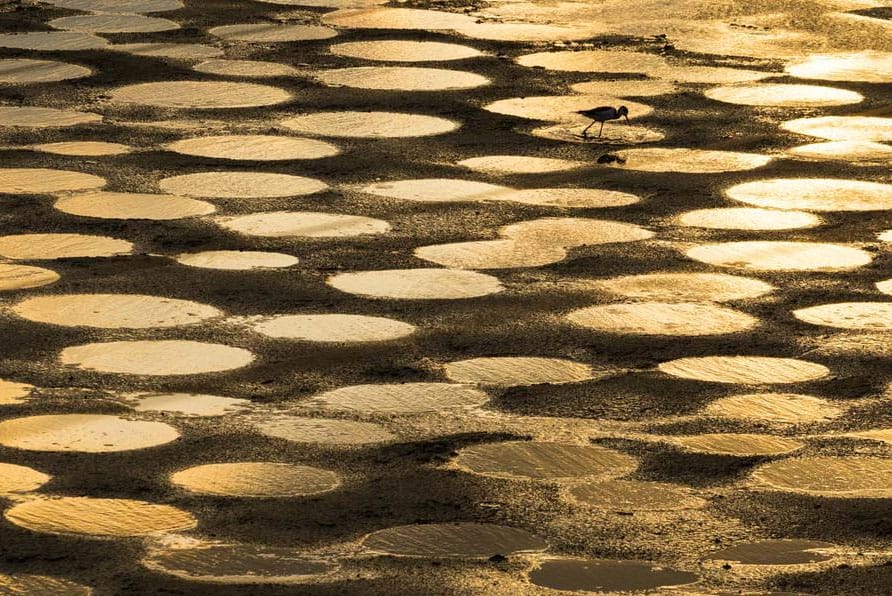
Tell us the story behind your winning photograph ‘Fishing in the Evening in the Hula Valley’.
This photo is based on a beautiful story about wetland conservation as an important stage for birds crossing Israel in their migratory flights between northern territories of Europe and Asia and Africa.
The collaboration between Hula Valley conservationist non-governmental organisations and fish farms plays a crucial role for offering resting sites to birds.
Sighting during an afternoon among fish farm ponds, I was attracted not by the huge concentration of birds resting nearby the water but for a quiet pool with remaining small ponds at its bottom due to fish movement. The light was gorgeous, shining on them and giving a golden ambiance to the moment. The concentration of a black-winged stilt fishing among them gave me the shot.
How did you go about getting that shot?
When I saw the circles pattern with such beautiful natural light I made my decision of getting something special of the site. The continuous motion of the bird wandering among the ponds gave me the chance of waiting for a good position of the bird for doing what I love the most on nature photography: catching surprising moments in wilderness.
How long did you have to wait for this shot?
It was a sort time because of the fading sun on the pond’s surface.
What sort of camera and lens did you use?
I used a camera Canon 7D equipped with a lens 70-300 mm.
What are the difficulties of wildlife photography you face?
Mostly to reach the site where is possible to shoot wildlife.
Sometimes you have to travel far away to get good pics. In Europe there are a lot of restrictions for taking photos of wild animals in nature and to get all the permissions in these rules could be a nightmare and a long stage. Also, this kind of photos require a more sophisticated equipment: heavy to carry, expensive and most difficult to manage in the wilderness.
What would you like people to think about when they see your work?
Through my passion and effort I want to show that most important to me is a commitment with nature and its conservation. So showing the astonishing wildlife of the Earth I hope to engage more and more people to recognise the essential importance of nature for us.
How long have you been a photographer and how did you get started in your career?
Since I had my university degree in Biology I went for using photography as a vehicle for being close to my passion, nature. However since my childhood wilderness was the best place in the world for me and I spent long time in nature.
What would you advise someone wanting to start taking photos of wildlife in their local environment?
First off, to learn about the local environment its natural process, deals of conservation and challenges to keep it untouched. Knowing and respecting the environment and spending more time in contact with nature is the way to be experienced about wildlife behaviour.
What have you been up to since the European Wildlife Photographer of the Year 2015 competition? What projects are you working on now?
I am engaged with conservation projects for the return of emblematic species as the Iberian lynx and bearded vulture in Spain. With my photo stories I am helping to protect more territories to be included at the Natura 2000 network.
I support international non-governmental organisations devoted to conservation issues. I work for Rewilding Europe shooting some of the areas included in this European project. Due to the interest of my photo travels I started to organise personalised trips to the most exciting hot spots of worldwide nature.
What are your favourite scenes to photograph?
I feel confident in wilderness, so I go for every scene. However I prefer natural ambiance with wildlife, it is the best way to show a habitat in an attractive and emotional manner.
Because just touching emotions we will engage humankind in preservation of nature.