


Have a banana
The first banana to be sold in the UK was at a shop in Holborn in 1633.
It drew a huge crowd and was a sensation. It would have been different from the shape and flavour that we think of as ‘banana’ today, and more similar to plantain.
The bananas that we eat today are all descended from the Cavendish Banana, a banana plant housed at Chatsworth House which was imported from Mauritius by Charles Telfair. Telfair, a colonial administrator and naturalist, is credited with having introduced bananas to Mauritius from China in 1826.
The original name for the banana is bound up in the name of the genus – Musa – and its origins in Papua-New Guinea. The name was likely the latinisation of the Arabic name for the fruit, mauz (موز), starting out as muku in Papuan languages.
Although the banana sold in Holborn was a spectacle, it took hundreds more years for the fruit to become commonplace in the British diet.
By the end of the 19th century there were regular imports of bananas coming from the Canary Islands. There was a preferential trade tariff for empire-grown bananas, a system designed to maintain Great Power status for Britain.
In 1940 the importing of bananas was banned. Normally bananas were transported on refrigerated ships, but these were needed for the war effort. Bananas became a symbol of the end of the war, when bananas might be bought and eaten regularly once more.
Avocado not on toast
They seem totally ubiquitous on our brunch plate and have become a symbol of generational divide. But did you know that when avocados were first stocked in Marks and Spencer in the 1960s, they were sold with leaflets explaining how to prepare and eat them?
Despite baffling Marks and Spencer customers in the swinging 60s, there is evidence that avocados were eaten by humans in Central America around 10,000 BC.
Nobody is actually sure how they have persisted to the present day. The size of their seed, combined with the lack of animals large enough to pass it (we believe they were a favourite of the giant ground sloth), mean it should have died out a long time ago. It is an evolutionary anachronism, which seems to have been supported by domestication by people in Central and South America.
Avocados are mostly grown in Mexico and Spanish writer and coloniser Gonzalo Fernández de Oviedo is said to be one of the first Europeans to try an avocado. He was part of the Spanish colonisation of the West Indies.
The avocado had long been consumed by populations in Mesoamerica (present day Mexico and central America) and South America, where it was known by the Nahuatl (Mexican) word āhuacatl. It was then brought to the rest of the world by conquistadors and colonisers like Gonzalo Fernández de Oviedo.
As colonisers pushed inland the avocado spread, including to Jamaica. In 1655, Britain colonial forces took control of Jamaica from the Spanish, and the avocado began to be written about by the English. One person in particular who wrote about it was Sir Hans Sloane, who catalogued Jamaican plants in 1696, including the avocado.
Symbolic pineapples
When pineapples arrived in the UK they were seen as a symbol of wealth and power and were an accessory of the rich. Once you start looking for it, you can spot pineapples dotted throughout the art, design and architecture of many of the country’s stately homes, like the Dunmore Pineapple.
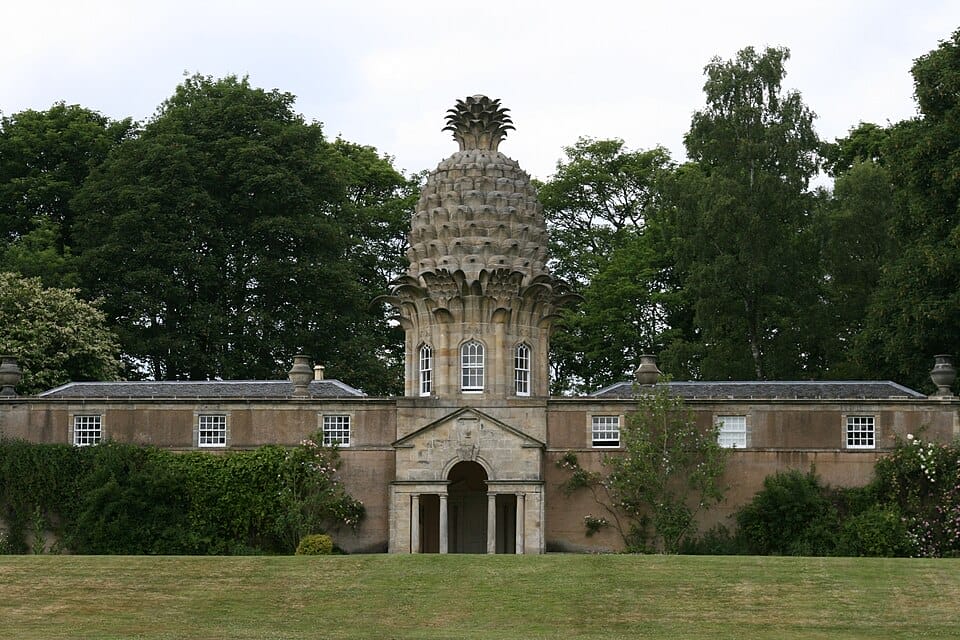
Dunmore Pineapple. Image by Giannandrea CC BY-SA 1.0
Pineapples were so prestigious in fact, that they wouldn’t even have been eaten. They would sit in the centre of the table to demonstrate the wealth and status of the hosts. Some people even rented pineapples for occasions.
But why was the pineapple venerated so much? In the 16th and 17th centuries foods began to be brought back from the Americas by Christopher Columbus to Spain.
These foods were viewed with fascination and wonder. Because the pineapple was previously unknown to European people, it had no lore attached to it already. The only thing that became attached to it, was its connection to wealth.
Here we encounter Fernandes Oviedo Valdes again, who included woodcuts of pineapples in his chronicles of the Indies. This played a huge role in popularising and mythologising the pineapple in Europe.
Not only would it have been costly to acquire a pineapple, but once people began to cultivate them in the UK, that too became an expensive business. They require warm and bright spaces to grow, so proving that you could house and grow pineapples became its own kind of status symbol.
The pineapple’s journey to the UK is bound up with the slave trade in the Caribbean. Richard Ligon, a plantation owner and enslaver, tried to import the fruit unsuccessfully in the 1600s.
Agnes Block is thought to have been the first to bring a pineapple to fruit in Europe in 1687. A Dutch art collector and horticulturalist, her greenhouses were populated with specimens collected for her by the Dutch East India Company. Their journey from the Netherlands to the UK was helped by rulers of the Dutch Republic William III and Mary II, who brought Dutch gardeners over during their reign.
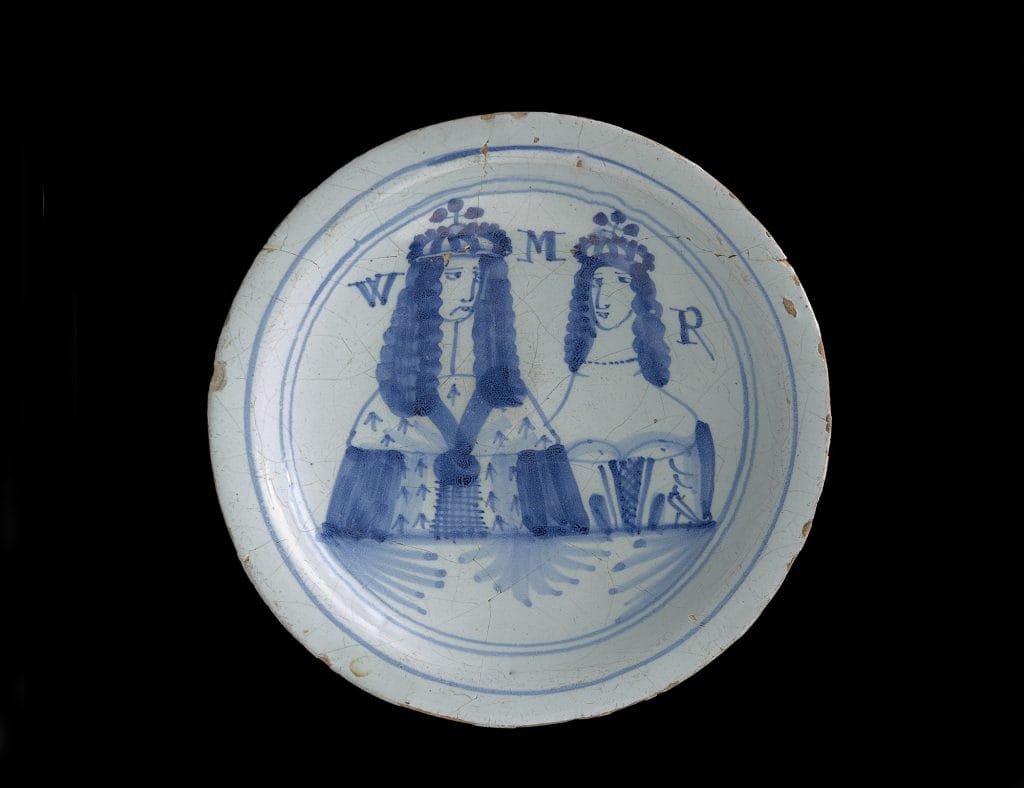
King William and Queen Mary, joint monarchs
The Dutch also imported the pineapple to Dutch colonies in Surinam, and it was here that naturalist Maria Sibylla Merian created her illustrations of insects alongside the pineapple. Her knowledge relied on enslaved and indigenous people as sources of information and local guides.
Coffee houses to Costa
The first coffee house in London opened in 1652 and the site is still marked by a sign reading ‘Here stood the first London coffee house at the sign of Pasqua Rosee’s head 1652.’
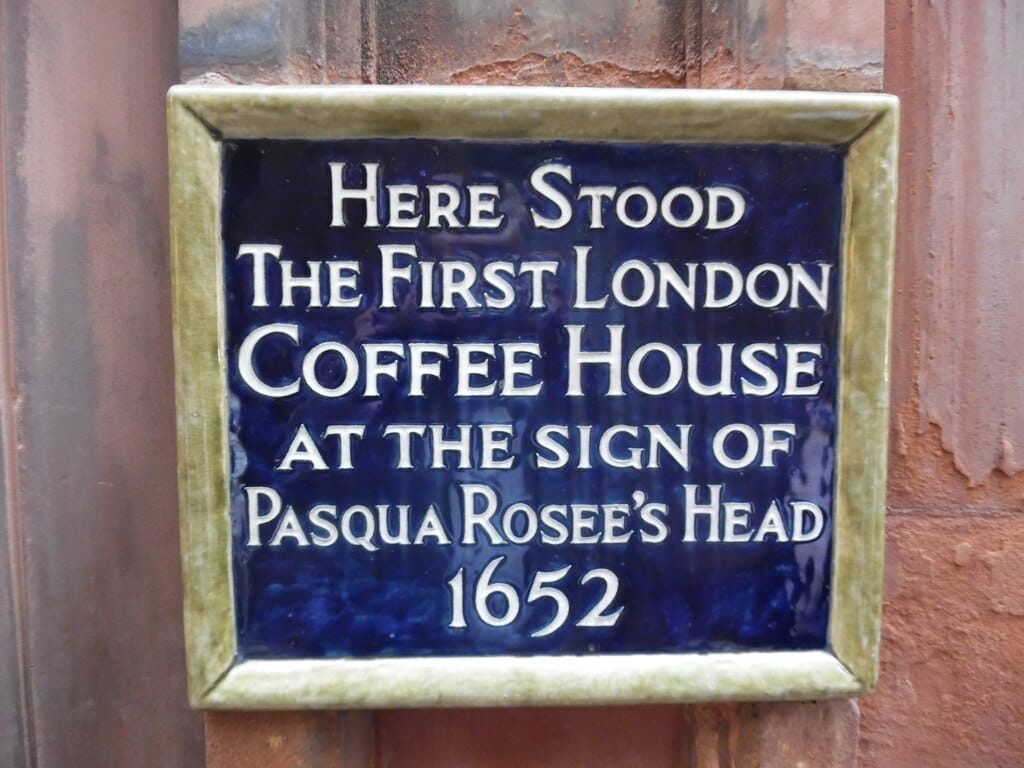
Image by David Hillas CC BY-SA 2.0
Pasqua Rosee was the Greek servant of a merchant named Daniel Edwards, who aided Edwards in trade with the Ottoman Empire thanks to his local knowledge and language skills.
On returning to Britian, Edwards grew tired of hosting guests in his home and instead opened a stall serving coffee in St Michael’s Churchyard, placing Rosee in charge. This proved so popular they were able to open a shop.
At the time, coffee culture was spreading across the capital. Predominately male spaces, coffee shops became a hive of talk, discussion and thought. Ideas were discussed – something which was thought of as a female past time, and a dangerous past time in the eyes of King Charles II who tried and failed to get them shut down.
As the popularity of coffee grew in Europe, European traders tried to secure their supply. Up until the end of the 17th century the Ottoman Empire had controlled the trade of coffee from their colony in Yemen (where it had spread to from Ethiopia). But as the 1700s began, the Dutch get hold of a coffee plant which they planted and cultivated on the island of Java. This is the first time coffee was grown outside of its indigenous area.
Similarly, the French planted coffee in the Caribbean and by 1789 they produced more than half the world’s coffee. Their plantations in Saint-Domingue (modern day Haiti) were worked on by enslaved people.
When Enlightenment reached Saint Domingue/Haiti, enslaved people called for their rights and the Haitian revolution began. One by-product of the Haitian people getting their freedom was the destruction of the country’s coffee plantations.
Britain too established coffee plantations across British controlled colonies, including Kenya and Guyana. In 1796, Britain took power of Ceylon (modern day Sri Lanka) from the Dutch. They introduced coffee production in a destructive takeover, killing wildlife and using indentured labourers to do so.
Imperialist countries were profiting from growing demand for coffee and their ability to exploit people and land to grow and trade it.
In the 1860s, the disease coffee leaf rust began to spread throughout the plants, killing them and destroying the plantations.
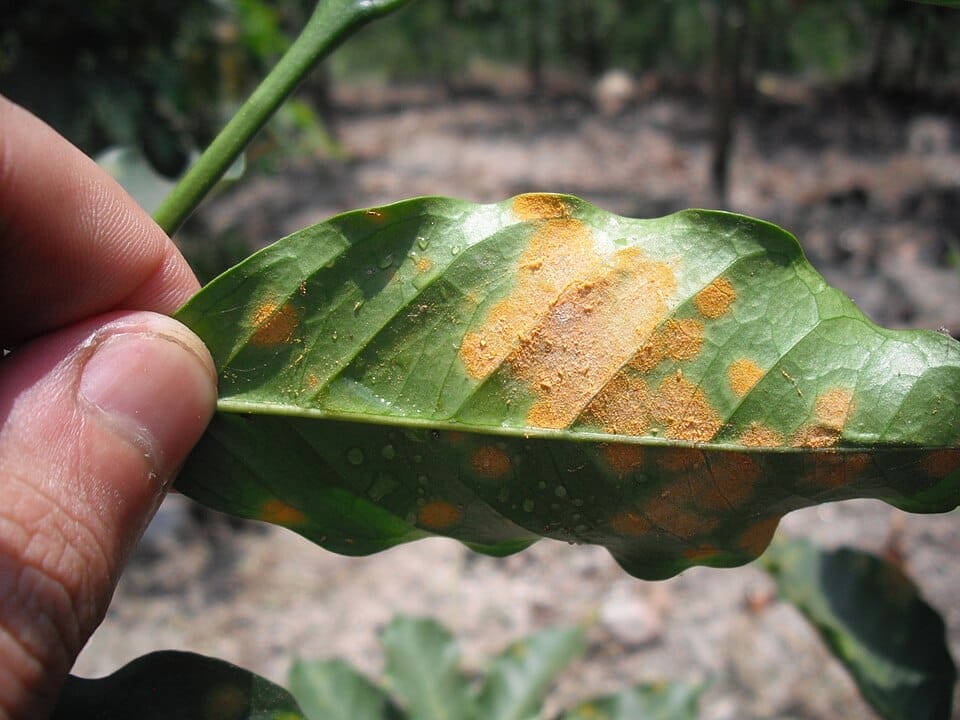
Image by smartse CC BY-SA 3.0
Rather than replenish with more coffee plants, tea was introduced instead (read more about the spread of the tea trade).
Coffee remained present in Britain, but coffee houses became elite, members only spaces. It wasn’t until more recent decades that coffee in the UK regained a foothold from tea, with Costa Coffee leading the way in the late 1970s and early 1980s.
Chocolate – to drink or to eat?
Chocolate was drunk by civilisations like the Maya and Aztecs for hundreds of years. Cacau, known as kakaw by the Mayans and cacahuatl by the Aztecs, is native to the Amazon. There is evidence of early domestication of the plant, as chocolate was considered medicinal and showed up in ceremonies from weddings to funerals.
Just like the 16th century banana did not taste like bananas now, drinking chocolate consumed by European visitors in the 16th century was much more savoury than what we’d drink today. In fact, chocolate was considered solely a drink and eating chocolate wasn’t in regular production at all until the mid-19th century.
Drinking chocolate was intertwined with coffee house culture, and chocolate houses were populated by the literati. They were a place for discussion and thought.
When the English imperialism took Jamaica – and its cacao plantations – from Spanish colonialists in 1655 drinking chocolate became more popular with the English.
However, the high import duties on the beans meant that it was only available to the very affluent.
Sir Hans Sloane is often cited as the first person to combine milk with chocolate, although this is debated and it’s more likely that he observed this combination on his travels to Jamaica.
He also claimed that chocolate had medicinal properties and was a natural aid to digestion.
In the 16th Century, the Spanish were keen to extract as much profit from cacao as possible. They put indigenous people of the Americas to work, mistreating them and allowing disease to flourish. This had a catastrophic effect on the native population. In response, the Spanish imported enslaved people from Africa. Humans were sold and exchanged for things like cacao and cotton as part of a ‘three-way trade’ system.
Chocolate bars may have existed for quite a long time too. In Europe, there is evidence that solid chocolate bars existed to be consumed as a food themselves, and not just broken down or grated into drinks, in letters sent by the Marquis de Sade from prison. One of the earliest mass producers of chocolate in Britain was Joseph Fry in the late 1700s. He used a steam engine to help mass production and went on to also create the first mass produced chocolate Easter egg.