


Meeting Mohini: Koovagam through the lens of Zoya Thomas Lobo follows the annual festival of Koovagam in Tamil Nadu, commemorating and celebrating the god Aravan/Koothavandar and his wedding to the goddess Mohini. The story of Aravan and Mohini is one of many within Hindu tradition that can be read and interpreted as a reaffirmation of the long and rich history of genderfluidity, trans people and LGBTQI+ communities. In this blog, we’ll offer context to the story of Mohini and Aravan and share some more that we may not be aware of.
The Mahabharata: Mohini, Aravan
The Mahabharata: Mohini, Aravan
The story of Mohini and Aravan takes place within the Tamil and Southern Indian versions of the Mahabharata.
The Mahabharata is a Hindu epic, written over two thousand years ago. It tells the story of the internal struggles of the Bharata dynasty and its two warring families, the righteous Pandavas and power-hungry Kauravas. Their power struggle leads both families and their allies to the Kurukshetra war, the decisive event of the Mahabharata.
On the eve of war, the Pandavas suggest a kalapalli, a sacrifice to the goddess Kali to ensure their victory. Krishna (god of compassion, love and empathy) avatar of Lord Vishnu and cousin to the Pandavas suggests that that only three people are suitable for a sacrifice to Kali. They are Arjuna, one of the five Pandava brothers and their finest warrior; Aravan, the son of Arjuna and the Naga queen Ulupi; and Krishna himself. Aravan chooses to sacrifice himself, saving his father and Krishna.
Rewarding his sacrifice, Krishna offers to fulfil whatever three requests Aravan asks for. Aravan’s primary request is to be married before his sacrifice. Krishna, not wanting any woman to be widowed after Aravan’s death becomes the goddess Mohini and agrees to marry Aravan.
Mohini and Aravan are married amidst great celebrations and spend only one night together before Aravan is sacrificed. Upon Aravan’s sacrifice, Mohini mourns and grieves deeply for their love.
Today, this story is remembered and reenacted at the Koovagam festival in Tamil Nadu where thousands of transgender women, as well as non-binary and gender non-conforming people take on the role of the goddess Mohini and honour Aravan, who is seen as a divine partner for trans communities.
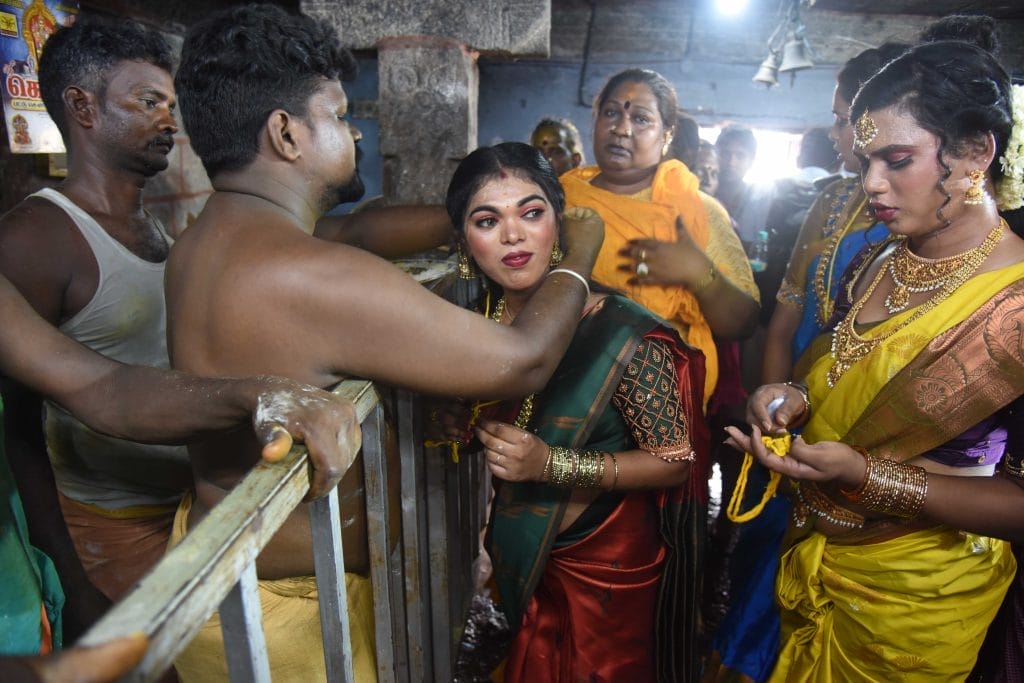
The wedding ceremony. Mohini marries Aravan in a ceremony at Koovagam temple. May 202, Credit: Zoya Thomas Lobo, Horniman Museum and Gardens
Mohini: The Enchantress
Mohini: The Enchantress
Lord Vishnu is the preserver of the universe and has multiple incarnations and avatars. The goddess of enchantment, Mohini, is Lord Vishnu’s only feminine avatar.
She is featured across many Hindu texts as well as local histories. With enchanting beauty, intellect and charm, Mohini has used her powers to defeat demons and secure amrita, the nectar of immortality for the devas, gods.
She is a divine partner of Lord Shiva, and they share a child together, the deity Ayyapa/Aiyanar who is worshipped across Kerala and Tamil Nadu today.
Mohini is a distinct deity in her own right, and is also worshipped across India as a kuldevi, familial deity.
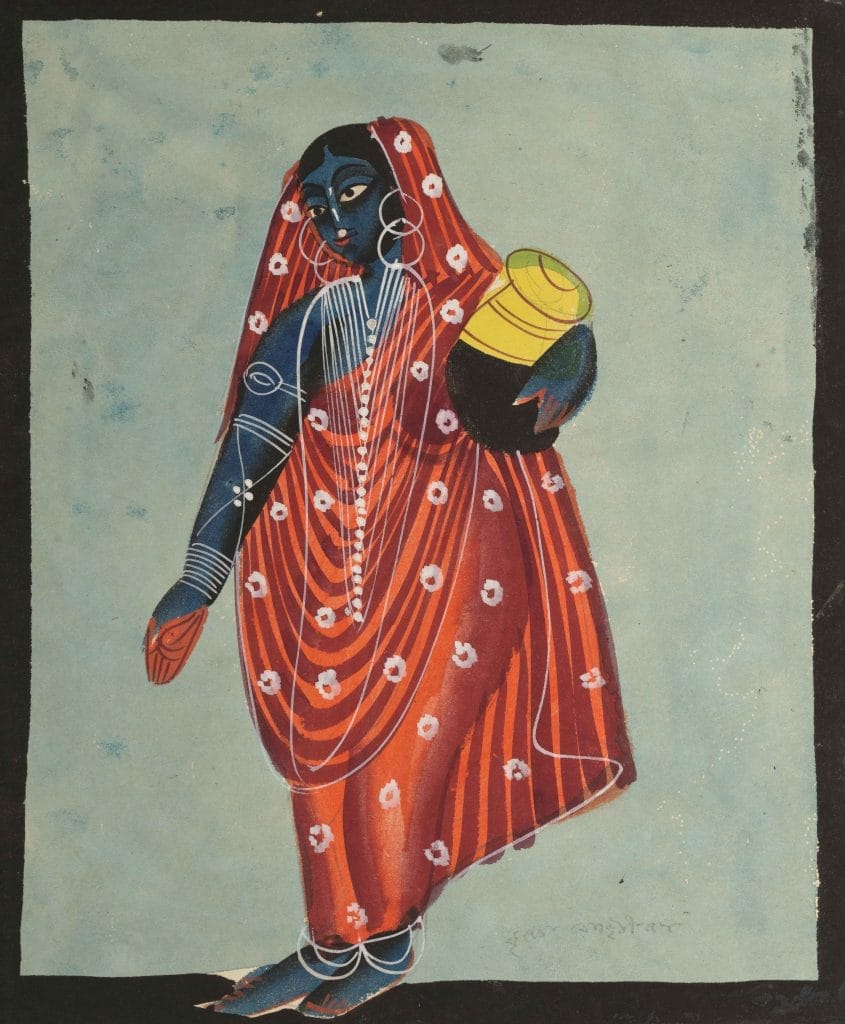
Mohini holds amrit, the elixir of immortality for the gods. 1890. Begal, Kolkata, Kaligha. Credit: Cleveland Museum of Art
Shikhandi, Amba and the defeat of Bhishma
The Kurukshetra war, the 18-day conflict between the Pandavas and the Kauravas is said to have seen immeasurable bloodshed with over two million combatants killed. Although a hard-fought victory was won by the Pandavas, it was prince Shikhandi, who, using contemporary language can be described as a transgender man, that played a pivotal role in the war.
Shikhandi was a prince of the powerful Panchala kingdom, allies of the Pandavas. Shikhandi’s father, King Drupada was told by the god Shiva that his queen would give birth to a baby who would transition at some point in their lives. Shikhandi was born and assigned female at birth but quickly began to express his male identity. The Panchala kingdom raised Shikhandi as a prince, and he became a skilful warrior and charioteer.
Upon his marriage to a princess of a neighbouring kingdom, Shikhandi was accused of lying about his identity and was misgendered – risking war between the two kingdoms. Shikhandi approached a powerful Yaksha, a powerful spirit of nature, who agreed to help Shikhandi undergo a physical transition, affirming his gender and ultimately averting war in his kingdom.
In Hinduism it is believed that upon death, a person’s soul leaves the body and is reborn into a new physical form. In Shikhandi’s previous life, he was the princess Amba who had been wronged by the great warrior and demi-god, Bhishma. Amba prayed to Shiva for justice and was told that she would be reincarnated as the person who would defeat Bhishma.
During the Kurukshetra war, Krishna, aware of Shikhandi’s past life, recruited him as a charioteer for Arjuna (father of Aravan) and one of the five Pandava brothers to face the fearless, indominable Bhishma who had pledged to fight for the Kauravas.
Some readings say that Bhishma refused to turn his weapon towards Shikhandi, recognising Amba’s soul. Others say that Bhishma refused to attack Shikhandi because he refused to accept his transition. In all cases, Bhishma stated he would not attack a woman, leaving an opening for Arjuna and Shikhandi to rain down a hail of arrows, defeating and ultimately killing him. In misgendering and not accepting Shikhandi for who he was, Bhishma paid the ultimate price.
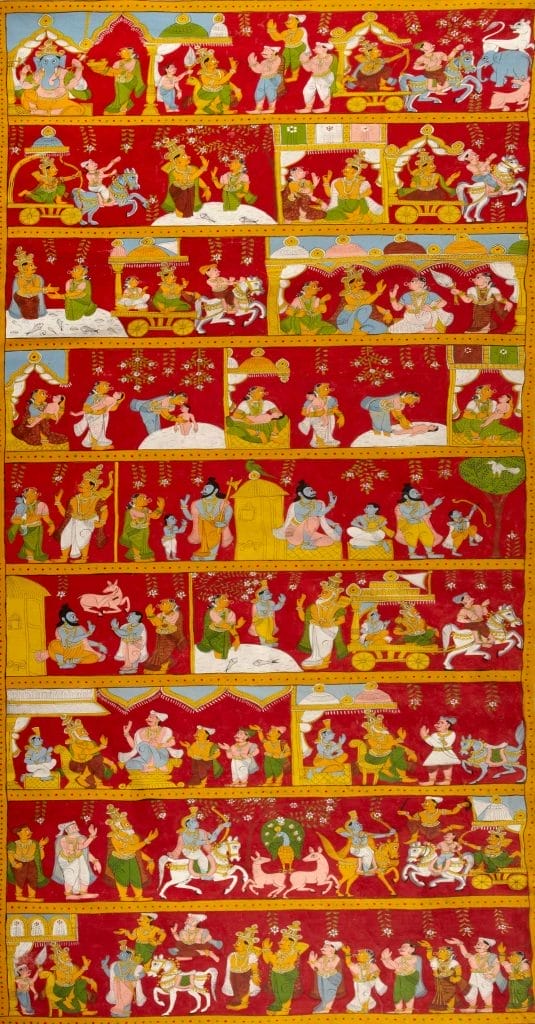
Scenes from the life of Bhishma – featuring his role in the Kurukshetra war
Arjuna as Brihannalla
The Mahabharata is considered an itihasa, a history, that is at least 2,000 years old. The story of Arjuna as Brihanalla offers us an insight into acceptance, respect and the societal roles that were afforded to transgender, non-binary and gender nonconforming peoples in ancient India.
During the events of the Mahabharata, all five Pandava brothers and their wife, Draupadi (all brothers were in a polyandrous relationship) were exiled for 13 years by their cousins, the Kauravaas.
In the last year of their exile, they disguised themselves and found work in a nearby kingdom. Arjuna disguises himself as Brihanalla, a dance and arts instructor who is described across texts as being “of the third gender” seeking a job in the royal court. Brihanalla was given a position in the royal court and, as an accomplished dancer and singer, took on the royal princess as a pupil.
It is important to note that the purpose Arjuna’s year living as Brihanalla was to be disguised and he presented a feminine persona. It is however another reference to genderfluidity in ancient India as well as the social acceptance of genderfluid, gender nonconforming, non-binary and transgender peoples.
Rama’s blessing
The Hindu festival of Diwali is from another ancient epic, the Ramayana (an epic believed to have been written three thousand years ago, older than the Mahabharata). It tells the story of Lord Rama, an avatar of Vishnu and his triumph over the asura, Ravana.
During the events of the Ramayana, lord Rama is exiled from his kingdom for fourteen years, much to the dismay of the people of his kingdom, who begin following him into the wilderness. Concerned for their safety in the jungles, Rama asks everyone to leave. Upon his return, years later, he realises that a group of transgender women, as well as non-binary and gender non-conforming people stayed, awaiting his return.
Touched by their devotion, he blesses them with the power to give their own blessings.
This story speaks not only to the existence of LGBTQI+ communities in ancient India but also to the strength and persistence of cultural memory. Today, many transgender women and feminine presenting non-binary people are asked for, and offer, blessings in return for a small donation.
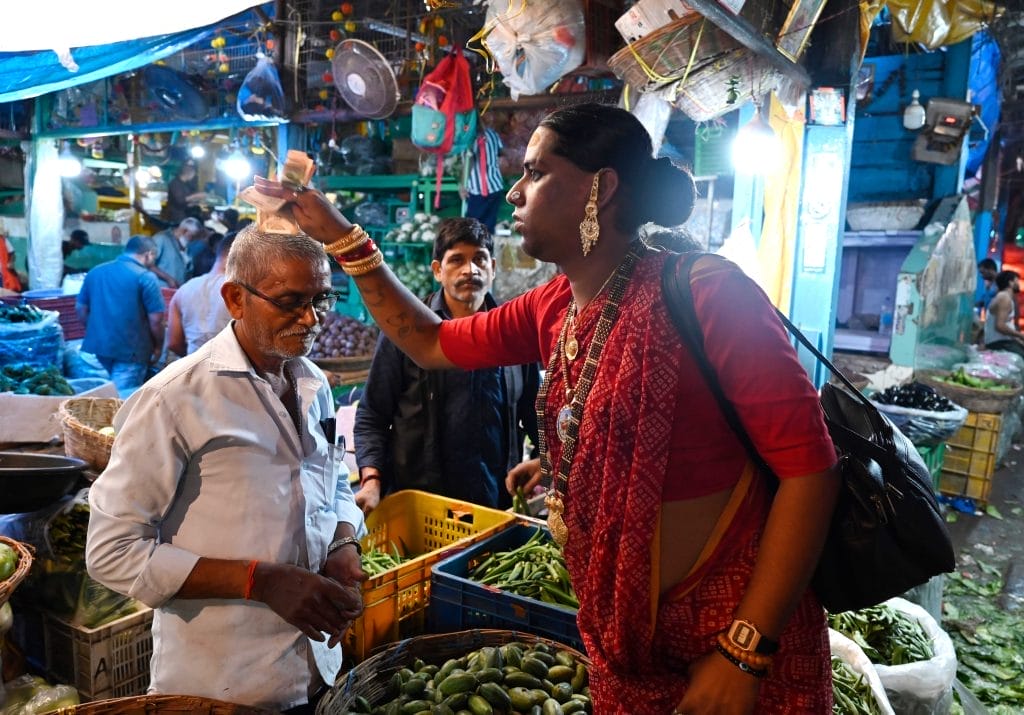
Zoya Thomas lobo giving a blessing to a stallowner in Maheem Market, Mumbai
Credit: Zoya Thomas Lobo, Horniman Museum and Gardens
Ardhanarishvara
The Ardhanarishvara (lord who is half woman) is a manifestation of Shiva (the god of destruction, transformation and rebirth) combined with Parvati (goddess of power, harmony and love). The divine consorts unite to form a singular cosmic complete being.
The Ardhanarishvara represents the idea that masculinity and femininity are part of a continuum, and the ‘complete being’ is all encompassing. This is critical in understanding the idea of oneness, a central concept in understanding Hindu philosophy. Advaita, meaning ‘non-dualism’, rejects the idea of binaries, arguing that all living beings belong to the same divine source.
Ardhanarishvara seeks to remind people that the soul, or the essence of a person, is rooted in something that is beyond binaries. To be a ‘complete’ being, it is important to understand femininity and masculinity are not separate, but part of one larger expression of who and what we are and choose to be.
In light of this philosophy, some scholars argue that supreme beings such as Vishnu or Shiva, at their essence, are above and beyond gender conformity and can manifest and incarnate as a host of beings that fit their purpose and need at the time.
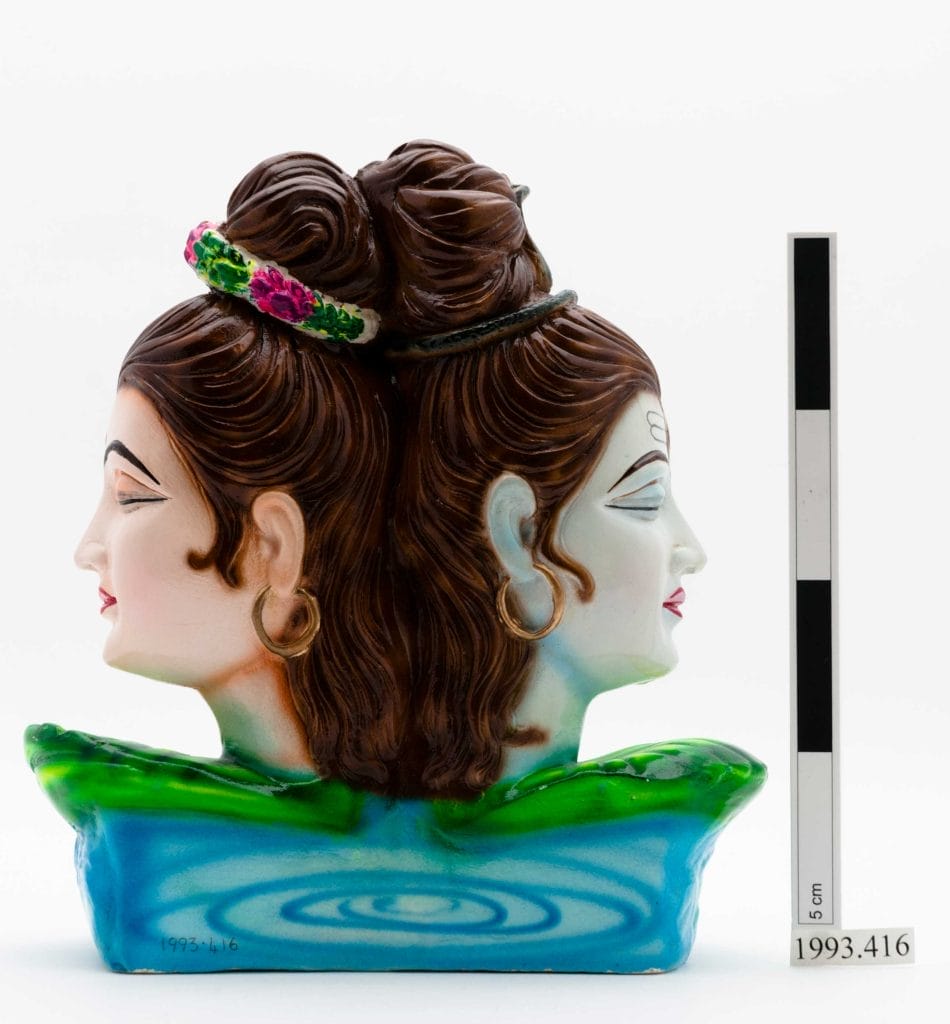
Parvati and Shiva
Kamasutra; Agni and Soma; Mitra and Varuna
Same-gender relationships have been mentioned across Hindu historical texts for millennia. The Kamasutra, one of the oldest discovered Sanskrit Hindu texts details same-gender relationships and partnerships. This is also mirrored in relationships between deities.
The deity Agni (fire and sun god) is in a polygamous marriage with Svaha (goddess of sacrifices and offerings) and Soma (the god of the moon). Agni and Soma represent a cosmic balance and dependency, the two embrace and share a union that is fundamental to their existence.
Mitra and Varuna are two devas, gods, who represent masculine companionship and love are mentioned in the Rigveda, an ancient collection of religious hymns. Although contemporary readings suggest that Mitra and Varuna are simply friends, there are readings of the Rigveda that suggest that the two share a sexual relationship and have shared children.
Amidst an ever-changing political landscape where queer communities face systemic marginalisation, these stories, rooted in ancient scriptures, are a reaffirmation of LGBTQI+ rights, history and culture. Using collections, cultural and spiritual belongings currently held at the Museum, the Horniman is able to share these stories with its audiences.
References:
Mahabharata BORI Critical Edition
- Adi Parva
- Udyoga Parva
- Bhishma Parva
Bibek Debroy, The Mahabharata (translation of the Mahabharata BORI Critical Edition), 2010
- Adi-vamshavatarna Parva: Chapter 58
- Ratha-Atiratha-Samkhya Parva: Chapter 832
- Amba-Upakhyana Parva: Chapter 853 – 856
Yajurveda; Satapatha Brahmana
- Fourth Brahmana, 4:1:4:44
Yajurveda; Shvetashvatara Upanishad
- Fifth Adyadha; 5; 10
Devdutt Pattanaik, Shikhandi: And Other Tales They Don’t Tell You, 2014
Sakshi Arora, Interpretation of the Character of Shikhandi as a Trans-Man, 2024
Sandhya Mulchandani, The Same Sex Kama Sutra, 2006
Wendy Doniger, Sudhir Kakar, Vatsayana Kamasutra (translation), 2003
Heinrich Robert Zimmer, Myths and Symbols in Indian Art and Civilization, 1972
Swami Nikhilananda, The Gospel of Sri Ramakrishna, 1942