


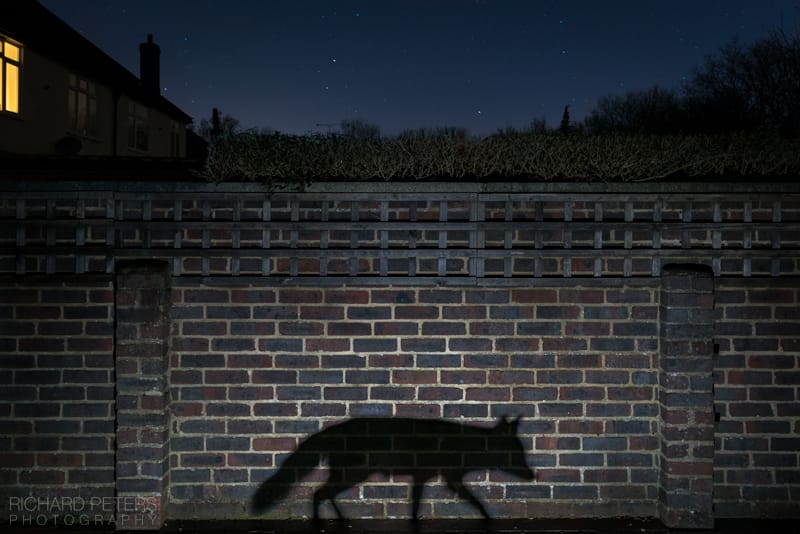
Tell us the story behind your winning photograph ‘Shadow Walker’.
For a while, we had no security light at the back of the house and so I would have to place a torch at the back door to see what was going on outside. One evening, a fox walked out along the side of the shed and through the torch light. In doing so it cast it’s shadow on the shed and as soon as I saw that, I knew it would make a great image if I could capture just the shadow of the subject. It took 6 months from that initial idea to finally figuring out how best to capture the image, in a way that helped convey the notion that foxes come out and forage in the shadows just as the human world is going to sleep.
I wanted a clear sky to show the stars, which required a night with little to no moonlight. The shadow needed to be both perfectly placed and positioned, and a finishing touch was the neighbouring light being left on. Using a camera trap was the only way to capture the desired photo, meaning I had to pre-visualise the photo and set the camera accordingly. With all those elements needing to come together, it was a frustrating photo to take, with many failed attempts before it all finally came together.
Did you get to know the foxes in your local area before taking the shot?
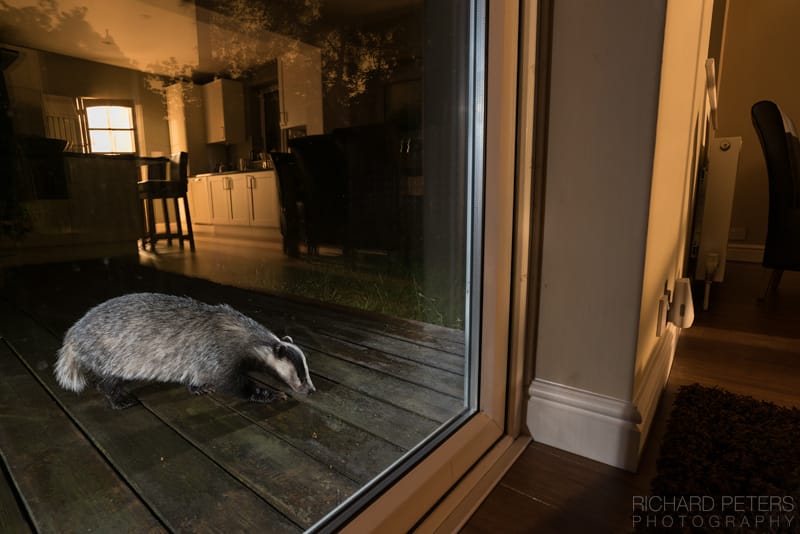
We moved into our house a year before I started photographing the local foxes. Actually, for the first year of living there I didn’t even know we had a local population as I never saw any. Then one weekend, a friend stayed the night and commented how he had seen a fox in the garden early the next morning. After that revelation, I started to pay more attention to what was going on outside and what wildlife I could attract to the garden, with bird feeders and fresh water. In doing this, the local foxes started to pay more attention to the garden, and so I put a trail camera out to monitor the activity further. In doing that I also discovered I had badgers visiting the garden too! The entire process of photographing them became a year long project I called Back Garden Safari, which spawned an ebook and popular talk.
Did you use any particular equipment?
My camera bag is no doubt very similar to many other photographers with a selection of DSLR’s, lenses and various accessories. I’ve always used Nikon equipment, currently shooting with two D810’s as my main bodies, but aside from the typical kit I also use camera traps occasionally to try and capture images that wouldn’t be possible with conventional methods. I try not to limit myself to one particular type of shot however, which is why I use a variation of traditional and camera trap methods, depending on the circumstances.
Light features heavily in your work, what do you think light expresses about wildlife?
Animals have their own personalities, thoughts and feelings and I often believe those traits can be better portrayed in a photograph through interesting use of light.
What would you like people to think about when they see your work?
Although I shoot first and foremost to satisfy my own artistic vision, I would like to hope the style of my work connects on some form of emotional level with the viewer and that in doing so, it can inspire them give more thought to a species under threat or give more thought to their local environment, and how wildlife is being forced to adapt to survive. If it can have that impact even only 1% of people who view my work, and that emotional connection prompts them to take action in their own little way to help preserve the planets wildlife, I would be thrilled.
How long have you been a photographer and how did you get started in your career?
I’ve always had a natural creative streak, favouring art and design over more academic subjects. On top of that I grew up watching natural history documentaries in which I remember always being amazed by the sights they would show. Then, when a friend gave me an old film camera to play with it was only a matter of time before my creative side and enjoyment of the natural world came together. I then dipped in and out of photography over the years whilst is remained a hobby against my day job in the media industry. Then about 6 years ago it became a more serious endeavour an I started committing more time and effort into capturing images. Eventually, a set of circumstances all came together at the right time enabling me to switch my career path to fully embrace photography.
What would you advise someone wanting to start taking photos of wildlife in their local environment?
Absolutely do it. Local wildlife can be just as inspiring and photogenic as species found on the other side of the world. Taking common, every day, species for granted can slow your creative growth. But more than that, paying more attention to your local environment and what lives within it, can help you tune in to your surroundings and appreciate them in a way you may not have thought possible. Spend time in your garden, a local park or any outside space. Sit, wait, watch and listen. You’ll be amazed how much wildlife is actually all around you on a daily basis. Use these familiar subjects to practice your composition, exposure and understanding of how to adapt to the light.
What have you been up to since the European Wildlife Photographer of the Year 2015 competition?
A year on and I’ve been keeping very busy indeed. I’ve been co-hosting workshops in Greece, Skomer Island and Africa, as well as running one-to-one tuition days, hosted talks ranging from the Natural History Museum to The Photography Show and, a career highlight, was asked to join Nikon UK’s Ambassador programme. I’ve also been building up a relationship with the Surrey Wildlife Trust over the year and hope to do some more work with them in due course, which would be great as it means working more in my local county. I was also asked to be one of the contributing photographers for the Born Free Foundations Remembering Elephants book project, aimed at raising awareness and funds for elephant conservation. Then of course the garden has also continued to repay me for my efforts with four other images going on to be awarded in various competitions. More recently, I’ve been planning an exhibition in collaboration with the WWF-UK. It’s been an enjoyable and busy year!
What are your favourite animals to photograph?
I always feel like it’s a slight deflection of the question when I answer this but in truth, I’m far more interested in the mood, drama or visual appeal of the photo than I am the subject within it. That being said, I’ve always favoured mammals over birds although I must admit I’d never turn down the opportunity to photograph an owl or raptor of some sort. I have a really strong desire to visit Alaska and photograph the bears out there, so finding the right opportunity to do that is definitely high on the list.
To find out more about Richard’s work, please visit his website www.richardpeters.co.uk