Map of the Wider Caribbean
During the tour, do interact with the map to link the islands and associated objects.
The Wider Caribbean is a geographical area comprising of the Caribbean Sea, the Gulf of Mexico, and the adjacent Atlantic Ocean. It consists of many islands, nations, and overseas territories such as Bermuda. They all have a shared history of European colonisation, and a mix of African, European and indigenous cultures.
Caribbean material culture reflects this mixture of cultures. Museums have not always been interested in acquiring these cultural objects. In general, when acquired, the objects end up in storage. The Horniman is no exception. It has some 500 Caribbean objects. The majority of these are in storage.
This tour will highlight objects on display that are either from or associated with the Caribbean, and look at their colonial histories, cultural and spiritual heritage, and traditions.
Your tour starts in the World Gallery.
This original 1901 Gallery tells the story of Frederick John Horniman, founder of the Museum and his Collections. These objects are from countries around the world and inspired by the 1851 Great Exhibition in Hyde Park.
Horniman was a tea trader and inherited the business from his father. The profits were the source of his wealth and the Collections. Today, it is acknowledged these are the results of profiting from the exploitation of peoples under colonial subjugation. Museum tea and tea ware collections are inherently colonial due to the drink’s relationship with orientalism, the Opium Wars and sugar production.
Horniman’s Roots
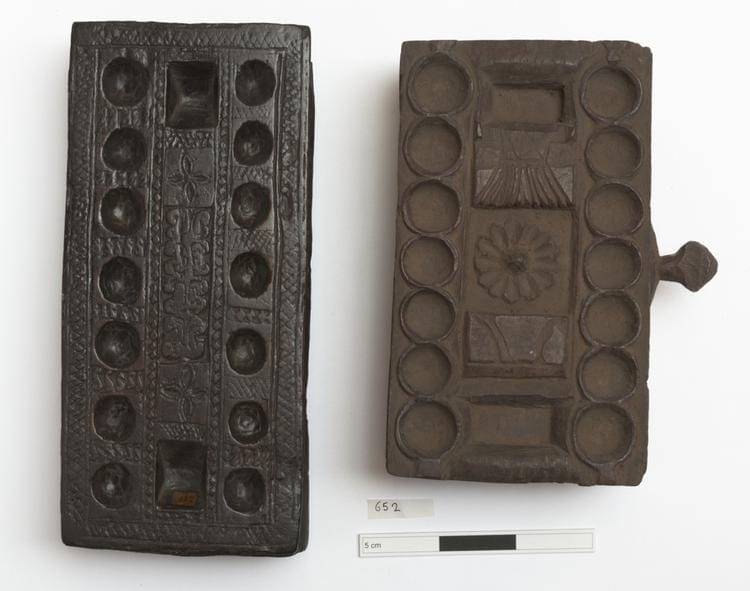
In the Gallery we see a mancala board from Sri Lanka. This is an ancient board game of strategy, thought to have originated in Sudan, 3,600 years ago. It was used by engineers and accountants of the ancient Kush Civilisation to carry out mathematical calculations.
Later it was brought along the Silk Road to central Asia with the spread of Islam, and to the Caribbean by the enslaved Africans, taken there to work on the sugar cane plantations. Until recently, the game was only played by men.
Unsurprisingly, with its rich, diverse history, it has several names – Ayo (Yoruba, Western Nigeria), Bao (East Africa), Oware (Ghana) and in the Caribbean Islands of Barbados, Antigua and Barbuda, it is known as Warri – ‘The Game of Houses’. On these islands it is played socially and culturally, being used in schools to develop students concentration, strategy and problem solving skills.
World Gallery Balcony
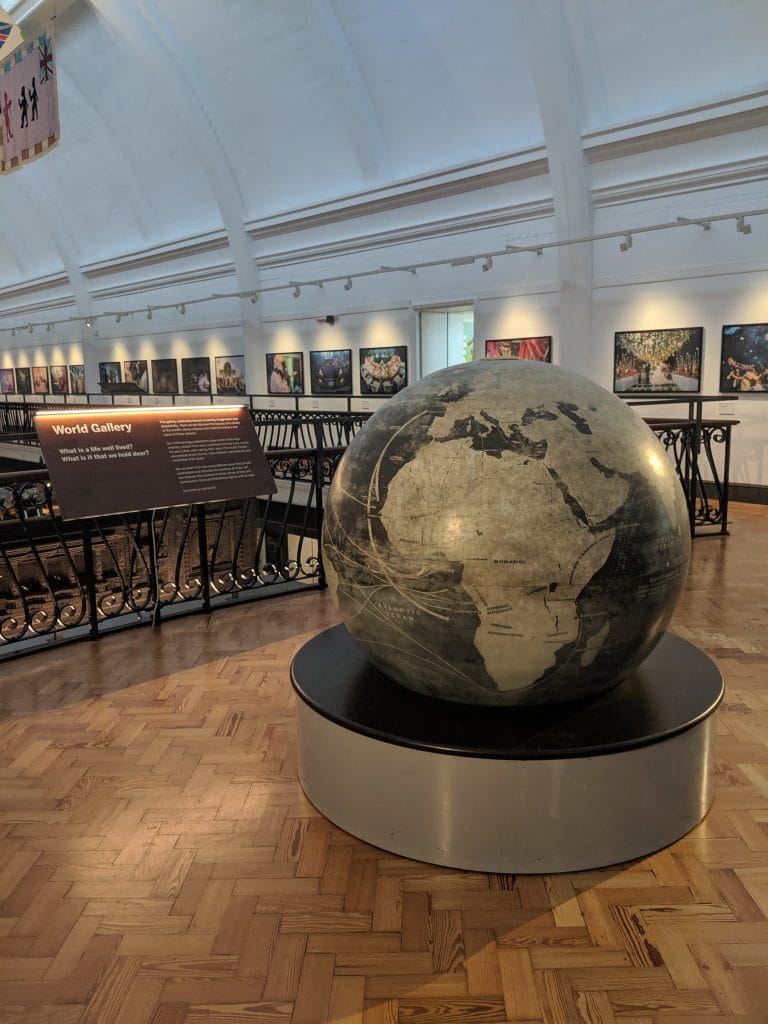
Blue Earth, a sculpture about the Atlantic slave trade
On the World Gallery Balcony you will see a metal sculpture in the shape of a globe – this is ‘Blue Earth 1807-2007’. The artist Taslim Martin was commissioned by the Museum to create a permanent memorial in 2007 commemorating the bicentenary of the Abolition of the Slave Trade Act 1807.
Though a catalyst to ending slavery in the British colonies, slavery itself was not abolished until the Slavery Abolition Act of 1833, eventually taking effect on 1 August 1834, ending slavery in most British colonies. The exceptions included those islands controlled by the East India Company.
Increasingly Emancipation Day is commemorated in the UK on 1 August. The sculpture shows the triangular trade routes used for transporting both enslaved Africans to the ‘New World’, and plantation produce including sugar, cotton, and tobacco resulting from enslaved or indentured labour.
Look closely at the sculpture. Trace the mancala’s route from East or West Africa to Barbados, Antigua and Barbuda in the Eastern Caribbean.
This artwork opens up conversations about the historical past of the British Empire, and the colonial history of the Museum’s collections.
Objects like this on display in the Museum encourages a more diverse audience. It opens up hidden narratives, thereby giving more inclusive histories, ultimately helping to decolonise the Museum’s Collections.
American Encounters, World Gallery
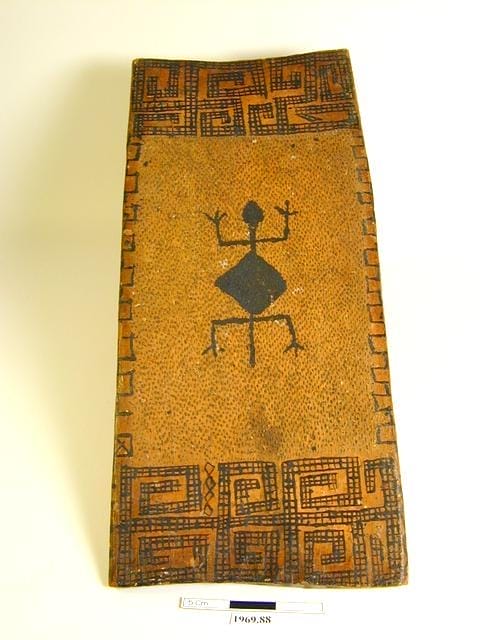
Although Guyana is located in South America, on the North Atlantic coast and not the Caribbean Sea, as a former British Colony, historically and culturally it is part of the Wider Caribbean.
Most of the objects in the American Encounters case were collected between 1950 and 2004.
They formed part of the Museum’s 2005 exhibition on Guyana’s oldest indigenous population, the Waiwai people.
Cassava, also known as manioca or yucca, originates in South America and is a popular ‘ground provision’ in Caribbean diet, used to make flat bread, puddings and sauces. It has natural cyanide so must be properly prepared, by washing it well before cooking.
In the Lesser Caribbean Islands, such as Dominica, the indigenous group Kalinago, or Caribs, like the Waiwai people, cultivated cassava as a staple food.
Guyanese use cassava root with added spices to make cassareep, a seasoning sauce and a natural food preservative used in their national dish pepperpot.
Martinique‘s dish, Féroce d’Avocat, (fierce avocado) is its most traditional dish made with cassava flour. Other ingredients include mashed avocado, salted cod, and of course the hot pepper sauce, hence its name.
Historically, this was the main diet of sugar cane plantation workers in the French Caribbean. Now it is a popular starter dish in French Caribbean meals, and a highly celebrated part of their culinary heritage.
Bermuda is a self-governing British overseas territory, and part of the Wider Caribbean because of its colonial history, and Caribbean cultural heritage. Traditionally, the must have delicacy on Christmas Day is savoury cassava pie.
Look closely at the Cassava grater. It is a beautifully crafted object made in a traditional design, from local hard wood and covered with very sharp stones.
Perspectives, World Gallery
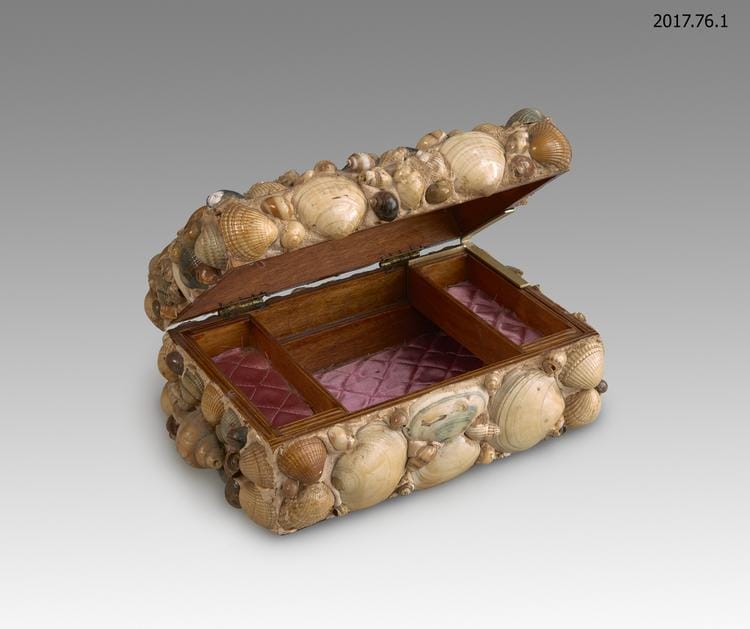
A sewing box is a common object in a Caribbean household, along with the sewing machine. Post emancipation the ability to sew was an essential domestic skill for women in the Caribbean, while for some it was a source of income. Today, these skills are still highly sought after in Caribbean families and diaspora communities.
The sewing box brought from the Caribbean held the dressmakers’ tools. These include pins, needles, scissors and fabric markers, used to alter and maintain outfits and household items.
Resourceful dressmakers use various containers to store their sewing items, evolving from simple baskets made from grass to repurposed boxes, tins and ornate wooden boxes.
These creative individuals not only use the sewing tools to make unique, personalised items, creating family histories. Some work with communities to make costumes expressing identity, resistance and heritage for cultural events such as carnival.
Dressmakers continue to maintain cultural traditions and play important roles in the social and cultural life in the community. The dressmaking skills, sewing machine and the sewing box together with its tools are often passed down through generations. The tools kept in a Caribbean sewing box, like all other sewing items, are not just tangible objects. They embody family histories, identity, cultural heritage and much more.
Who knows what story this sewing box, decorated with seashells, holds!
Music Gallery
In the Music Gallery you are amongst some 1300 of the Museum’s wide range of musical objects from around the world.
Venezuela, similar to Guyana, is a South American country with shared characteristics historically, culturally, and in part geographically with that of the Wider Caribbean.
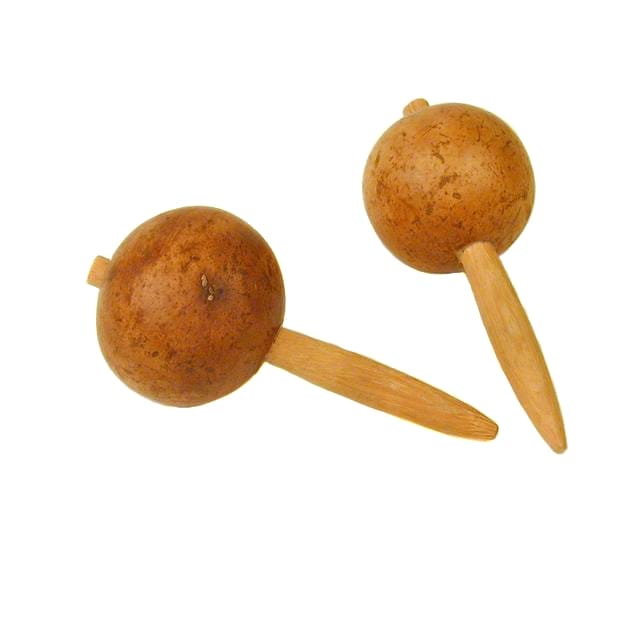
This pair of maracas, a handheld rattle is from Venezuela. The Maracas are amongst a group of percussion instruments known as vessel rattles, traditionally made from dried calabash gourds or turtle shell, and filled with beans, beads or pebbles. Used to keep the beat and give rhythm, they are very popular instruments in Cuban and Haitian music.
Music Gallery
Indo-Caribbeans are descendants of Indians brought to the Caribbean by the Dutch, English and French colonisers to work on plantations as indentured labourers after the abolition of slavery. In some Caribbean Islands such as Trinidad and Tobago, Suriname and Guyana they are the largest ethnic group in the population, with the second majority group being African Caribbeans.
Their strong Indo-Caribbean heritage is reflected in their music such as today’s popular chutney soca. ‘Chutney’ is the fusion of Indo-Caribbean musical traditions, whilst ‘soca’ is the up tempo beat that comes from using traditional Indian instruments such as the dhol, alongside modern instruments.
Indo-Trinidadian and Tobagonian musician and singer Sundar Popo Bahora is known as the father of the musical genre Chutney Music. Chutney Soca which started in Trinidad in 1987, is credited to Indo-Trinidadian artist, Drupatee Ramagoonai. The term is coined from her hit song ’Chatnee Soca’. This musical genre is a fusion of calypso and soca, with Indian folk music, English and Hindustani lyrics, Western and Indian rhythms.
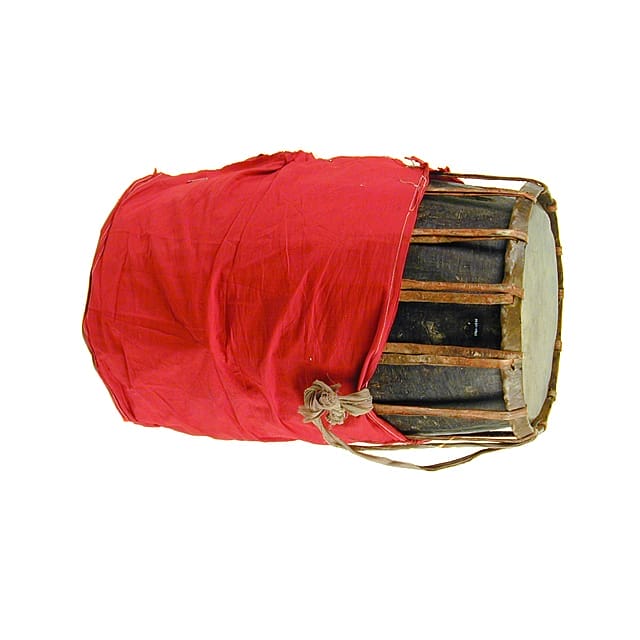
Traditional Indian instruments prominent in Indo-Caribbean music include the harmonium, a hand pumped reed organ, and on display in the Music Gallery is a dhol. This is a barrel shaped double-sided drum, played with beaters made from cane wood, or bamboo to produce a deep bass sound on one side, and high pitched sound on the other side. There is also a tabla. This is a pair of drums, one smaller than the other and both played with the fingers and the palms, making intricate rhythm and percussion sounds.
Indo-Caribbean music is significant as a symbol of festivity, unity, and sounds for celebrations, reflecting cultural diversity and spirituality in Indo-Caribbean heritage.
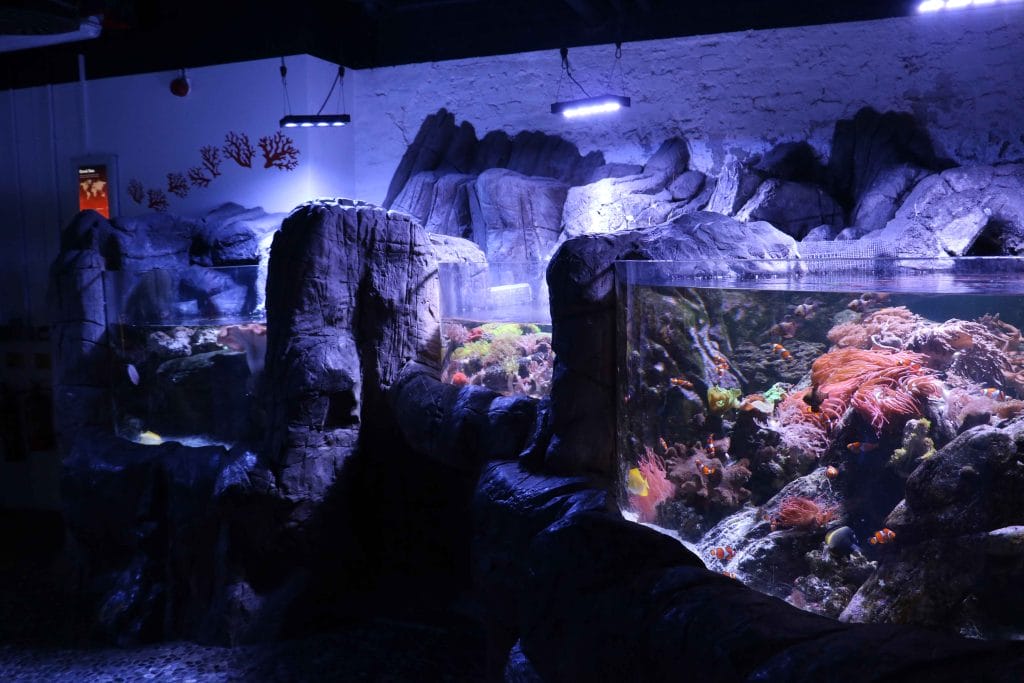
The Museum’s ongoing research on coral reproduction, aquatic environments on coral reefs, mangroves and rainforests from around the world is notable.
The Mangrove display in the Aquarium was developed with assistance from the University of the West Indies, highlighting the importance of mangrove forests in supporting bio-diversity and providing habitat for a variety of marine specimen.
Environmentally, the Caribbean region has a unique marine diversity, including coral reefs and mangrove forests. Trinidad’s mangroves and Guyana’s rainforests are highlighted on the wall map.
The sounds of nature including croaking frogs are present throughout the Aquarium. There are a range of corals, and unusual aquatic creatures in this man-made habitat. Visitors are encouraged and provided with opportunities to have an interactive experience. Take the opportunity to learn about symbiotic relationships in marine life and discover interesting and surprising facts.
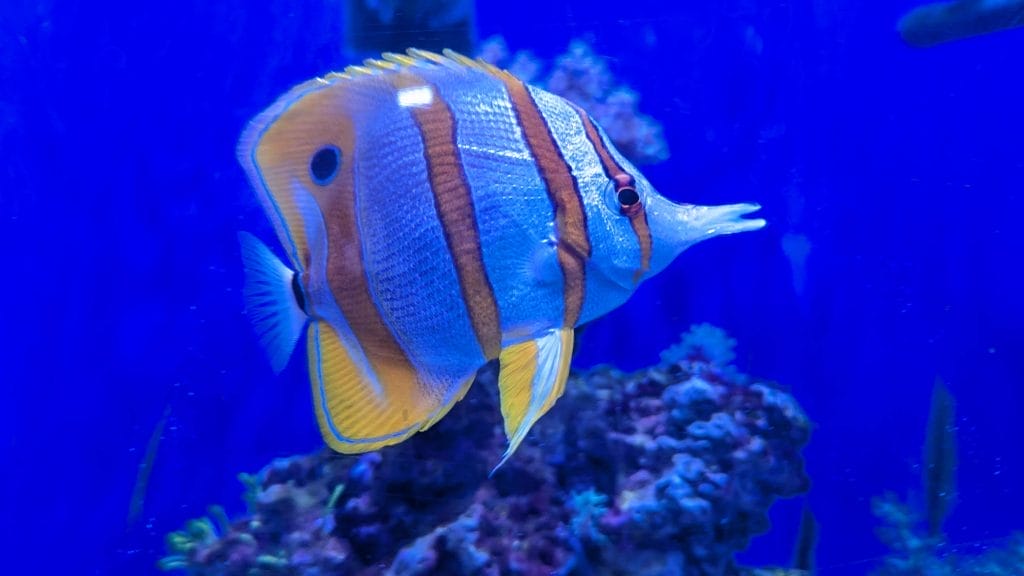
Don’t miss looking at the variety of fish, which may include the Butterfly Fish with their striking colours including shades of black and white. They live on coral reefs, and are native to the tropical, and subtropical western Atlantic ocean, and can also be found in the Caribbean. In recent years, its image was featured on Grenada’s postage stamp.
Sunken Gardens
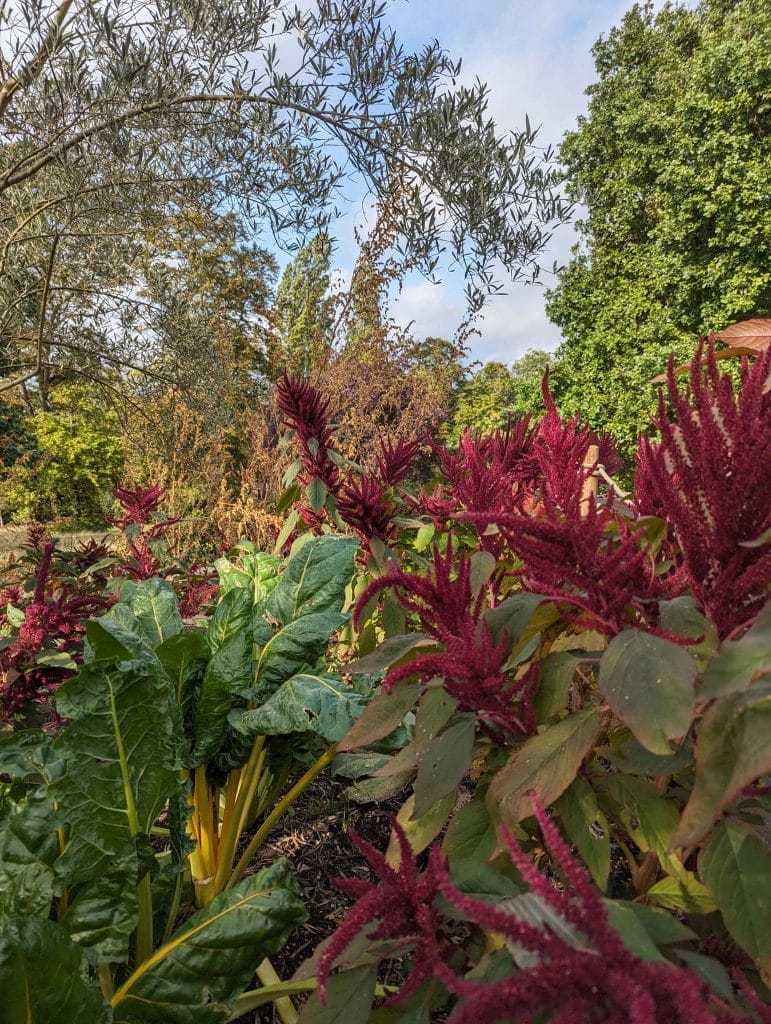
The Sunken Gardens are constantly changing with the seasons, and currently include herbs, dyes, medicines and materials.
There are plants which help to make products as diverse as building materials, textiles, and musical instruments – such as the dhol beaters from India, and Venezuela’s maracas vessel rattle. As noted by the Antiguan author and keen gardener Jamaica Kincaid ‘More than anything, a garden is about memories.’
We pick up the themes of nature and Caribbean foods, moving from the cassava to the callaloo, a leafy spinach like vegetable, germinating profusely in the Sunken Garden.
Variations in the spelling of the word ‘callaloo’, reflects the Wider Caribbean’s diverse population, languages and histories. In some islands such as Grenada and Trinidad and Tobago, callaloo is the name given to a dish made with leaves from dasheen or tannia plants.
In other islands, callaloo is the name of the plant used to make a stew. In Jamaica, callaloo is the most popular green vegetable.
In 16th century Trinidad and Tobago, during Spanish colonisation, the dish was created by enslaved Africans, using plants grown by the indigenous Taino population.
Today one of the Islands’ national dishes is crab and callaloo, representing a blend of Taino, African and later East Indian culinary traditions. Like many other foods ‘inherited’ from the colonial era, today callaloo is a staple dish throughout the Caribbean regions.
Butterfly House
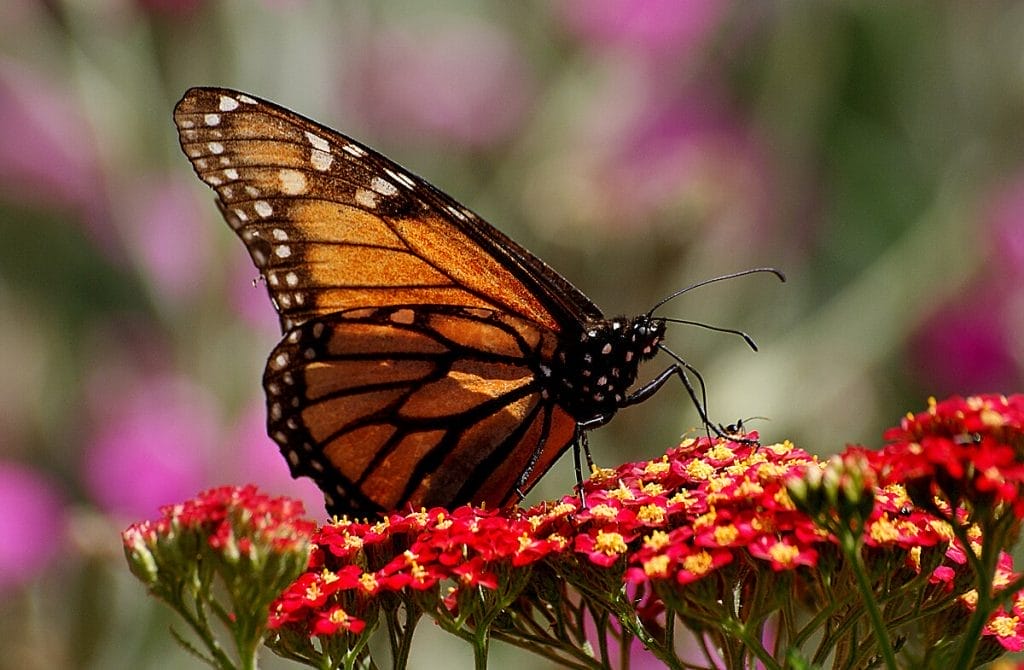
Monarch Butterfly, Creative Commons 1.0
Inside the tropical environment of the Butterfly House, look out for the Monarch butterfly.
It is the largest butterfly seen in the British Isles and was first recorded in the UK in 1876!
Iconic with its orange and black wings it is not exclusive to the Caribbean, but can be spotted in the regions during its 2000 mile migration from North America in winter to warmer climates.
Notice them feeding from the range of available food, predominantly nectar and fruits of flowering plants, many of which are native to or associated with the Caribbean. This includes hibiscus and even a banana tree producing fruits.
The most important plant in their life cycle is the milkwood plant, with the Monarch Butterfly laying its egg on the leaves. This is essential food for the hatched caterpillars which only eat milkweed leaves – no caterpillars means no Monarch butterflies!