


Annie Horniman, daughter of Frederick Horniman, was determined not to be like her family. She was estranged from her father for many years, particularly after he remarried a much younger woman following the death of her mother.
Growing up, entertainment in the Horniman household had to fit in with Quaker sensitivities. Theatre did not fit in with this and was strictly out of bounds. However, as a young woman, Annie secretly attended a production of The Merchant of Venice at the Crystal Palace. Her relationship with the theatre was born.
Annie and the theatre
Annie was an ardent fan of the theatre and was especially a huge admirer of the Irish dramatist and poet W.B. Yeats. The pair had met in London through the secret, magical order, the Golden Dawn.
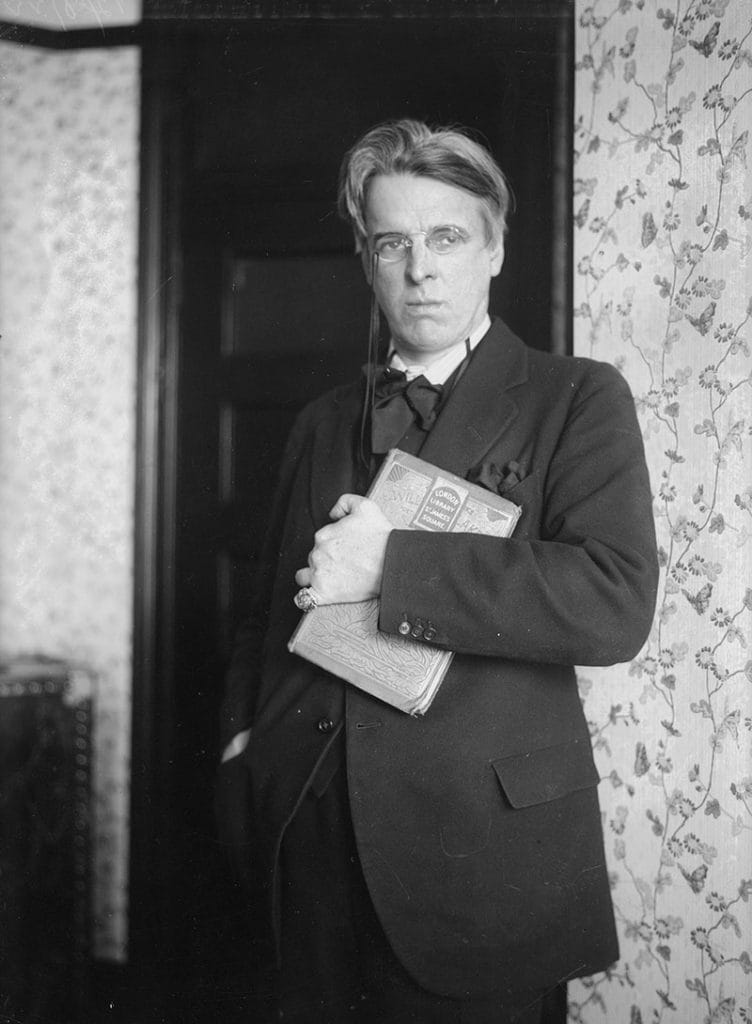
WB Yeats, who was a member of the Golden Dawn, Public Domain via Wikicommons
Annie used her wealth to subsidise Yeats’ work, supporting his early theatrical endeavours. She was his unpaid secretary and worked on costumes for his play ‘The King’s Threshold’. It’s not entirely clear what Yeats thought of her, but it’s likely that her financial backing made her a welcome figure in his eyes.
In 1904, Annie and Yeats joined forces with JM Synge, William and Frank Fay, and Lady Gregory to form the Irish National Theatre Society.
Irish nationalism was naturally a big topic for the Irish National Theatre Society.
Yeats was a nationalist. However, he also wanted the theatre they made to be artistic, drawing inspiration from European masterpieces.
Annie hated politics and didn’t want the theatre she was involved in making to be political at all.
Lady Gregory vs Annie
Lady Gregory was an Irish dramatist who was also a supporter Yeats as well as writing plays in her own right. She was a nationalist who wanted the theatre they made to champion Ireland.
Lady Gregory and Annie greatly disliked each other.
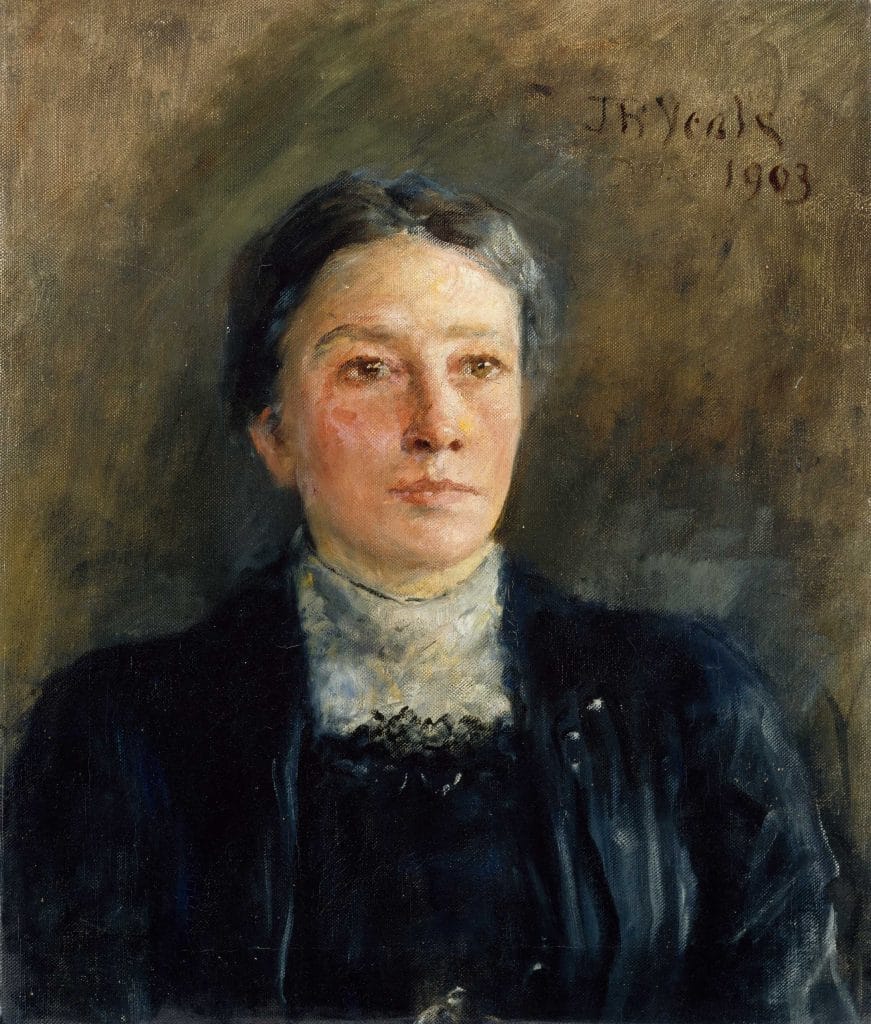
Painting of Lady Gregory by Yeats, Creative Commons BY 4.0, from the collection of the National Gallery of Ireland
Annie used her inheritance and bequests from her family to establish the Abbey Theatre in Dublin. Annie told Yeats that her financial investment could only be small and that it was up to him to make the theatre prosperous.
As well as not liking political theatre, Annie had no sympathy for the promotion of the Gaelic language, or sixpenny cheap seats. She did not care about making theatre accessible to all, and the Abbey ended up being one of the most expensive theatres in Dublin.
Annie wanted to turn the transform from what she called an ‘Irish toy’ into a dignified ‘art institution’. She wanted the plays to be from a broad repertoire – not just Irish and not just about nationalism.
Bearing Annie’s position in mind, it’s astonishing what the Abbey Theatre went on to achieve and the great Irish theatre that it became home to. This is largely due to the continued exclusion of Annie.
Annie was unable to apply for a Royal Letters Patent for the theatre as she wasn’t an Irish resident. Therefore, it was done in Lady Gregory’s name, creating the impression that Lady Gregory was the founder.
Annie was frequently omitted from lists of directors in the programmes. Lady Gregory reportedly said that Annie had made the building – but not the theatre.
Opening night and beyond
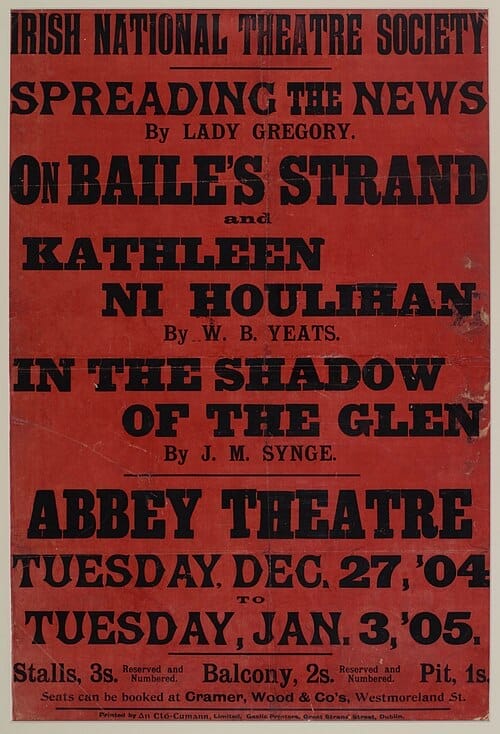
Image in public domain via WikiCommons
December 1904 saw the theatre’s opening night and the debut performance of three plays – ‘On Baile’s Strand’ and ‘Cathleen Ni Houlihan’ by Yeats and ‘Spreading the News’ by Lady Gregory.
Annie was not in attendance on opening night, with no record as to why she was absent.
However, the newly formed Sinn Féin were great supporters of the theatre. It may be that she felt that her presence alone was political.
Annie is a largely forgotten figure in the history of Irish Theatre. Meanwhile Lady Gregory and Yeats – and even the Abbey Theatre itself – are all considered to be pivotal.
In 1905, Yeats, Lady Gregory and J.M. Synge turned the theatre into a limited liability company without telling Annie.
In 1907, there were riots at the theatre following the opening of The Playboy of the Western World by Synge. Some rioters felt that the play’s celebration of a man killing his father and its depiction of women were immoral. Nationalist figures protested against the lack of patriotism within the play. The riots were so raucous that the actors on stage merely mimed their lines, being unable to be heard.
Throughout, Annie continued to express her disdain for nationalists.
She left the Abbey Theatre in 1907, becoming fully financially uninvolved in 1910 after the theatre stayed open on the day King Edward VII died.
When she left the Abbey, Lady Gregory said she was, “free from her and from further foreign invasion.”
Annie in Manchester
After leaving the Abbey, Annie went on to form a repertory company in Manchester. A 1907 letter in the Manchester Guardian (now The Guardian) announced that Miss AEF Horniman and Mr B Iden Payne were forming a repertory theatre.
We shall seek to produce good new plays, to revive old masterpieces and to present translations of the best works of foreign authors. We have chosen Manchester because we feel that of all towns it is the one most ready for such an undertaking, and that there will be the support necessary for the success of our scheme.
Annie and Iden had met at the Abbey, where Iden had been taken on a director. They wanted to produce plays of the moment, and that were of social significance. Annie read and replied to every script that was sent to her.
The opening play was a comedy titled ‘David Ballard’ by Charles McEvoy, and was staged at the Midland Hotel Theatre. Some of the more successful plays transferred to London, and the collective of home-grown playwrights whose work was produced became known as the Manchester School of Drama.
The Gaiety operated as a playhouse until 1917 when the company was disbanded due to the war.
Of course I shall be there – every corpse must attend its own funeral.
With thanks to Clare Paterson for her insightful book Mr Horniman’s Walrus.