


It’s included in original Museum plans and can be seen in countless photos in our 125-year history.
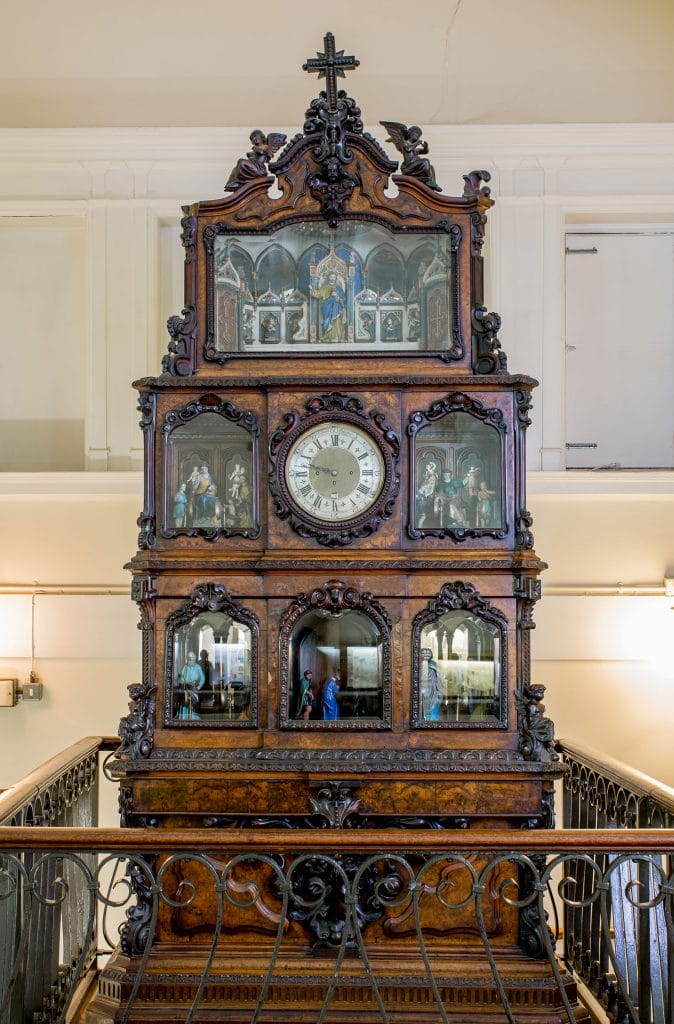
The Apostle clock on the Natural History Balcony, Sophia Spring
But we don’t actually know very much about its origins.
The Apostle Clock has stood at the end of the gallery, overlooking the Natural History collections since before anyone can remember. This is literal, as in our systems, it is recorded that we don’t know how it came to be in our collections.
Just how can such a whopping great thing sneak up on us? There are some thoughts that it belonged to Frederick Horniman and could not fit in Surrey Mount when the family moved. Perhaps they already had enough clocks?
What we do know, is that the wood is walnut, and is German. We know that it’s been at the Museum since it was opened in the present building in 1901, and it was intended to be included.
An architect’s drawing for the Museum in the London Metropolitan Archives shows the pencilled instruction: ‘place for Strasbourg clock’ in the balustraded area where the clock is now located.
The grand event
The clock chimes at every quarter of the hour, and on the hour.
However, at 4pm something exciting happens. Scenes from the life of Christ appear in the chamber below the clock dial:
- The nativity
- Christ talking to the elders in the temple
- Three Marys outside the sepulchre
In the compartment above the clock face, the apostles pass in front of Jesus, each bowing their head as they pass him. Judas is last, and rather than bowing his head he turns away.
The tableaux in the four side chambers represent the phases of man’s life, from childhood through to old age.
Whilst all of this is happening, the chimes that play are thought to represent old German hymns.
Visitors regularly tell us about remembering hearing the chimes when they visited as children. And why 4pm? It would have signified time for tea in the Victorian era that the clock was made in.
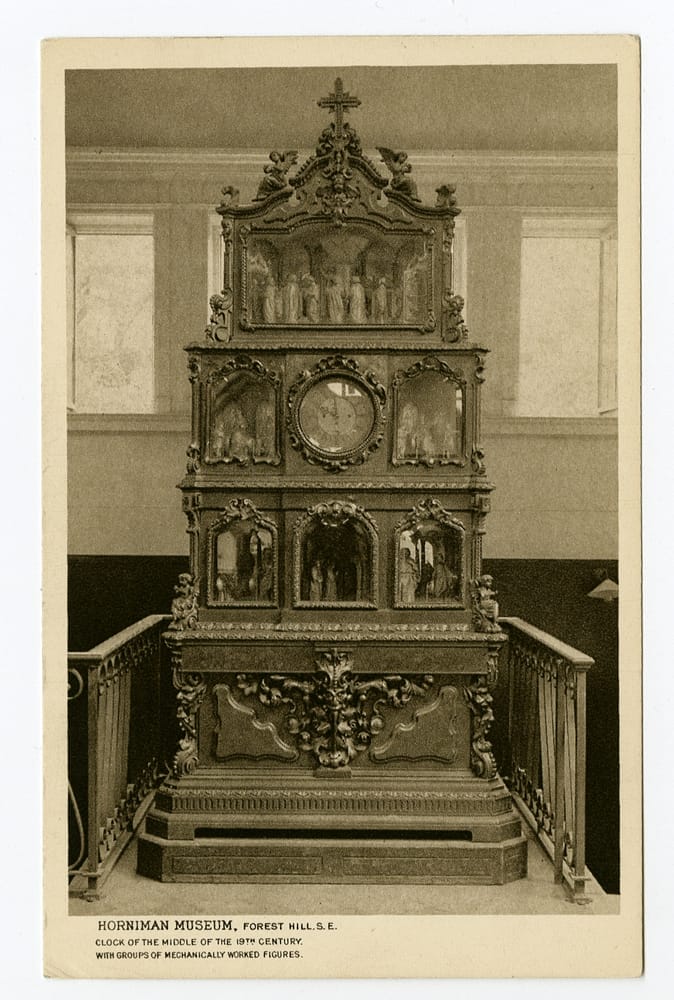
Postcard showing the Apostle Clock in the mid 19th Century
Winding the clock
The Apostle Clock is an eight-day clock, meaning it only needs to be wound once a week.
This job is usually carried out by our Visitor Hosts.
Mysteries of the clock
That’s all we really know about the clock – and even that is not for certain. In 2001 English Heritage made a report into the clock and spoke to a leading Horologist from the British Museum.
According to Paul Buck of the British Museum's Horological Department, the Apostle Clock does not come from the Black Forest at all. Although the clock is not signed, which remains somewhat puzzling, Mr Buck has stated that the case is probably German, and the movements are English.
Museum records suggested that the Clock was inspired by the Strasbourg Cathedral clock, considered the finest example of an astronomical clock. This too was contradicted by the British Museum expert.
Moreover, Mr Buck believes that the Apostle Clock is not a copy of the Strasburg Cathedral clock, as has been suggested since the early twentieth-century. He feels that its design is more inspired by the great clocks at Prague (Fig. 8), begun in the fifteenth century and reworked 1865-66 when the figures of the twelve Apostles were added, and Lubeck.
So the origins of this clock remain a mystery. But one thing is for certain – it’s much loved.