


Hi, I’m Diana Chausiku Mwangi — a community researcher from Kenya, who grew up listening to stories my grandmother would tell as she roasted maize over a charcoal stove.
There are things we carry with us even when we don’t realise it — stories, songs, bits of cloth, scents of home. For me, it was this apron. Not literally, but in memory. In the way women gather around a girl and tell her, quietly but clearly, who she is becoming.
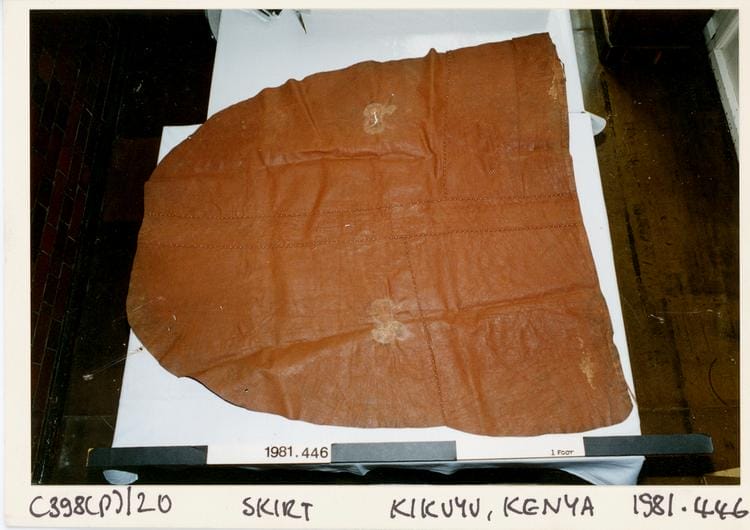
I wasn’t looking for it. I just found it in the digital archives of the Horniman. I didn’t expect a piece of soft, aged leather to stir up so much. Yet here I was, face-to-screen with an image of a traditional Kikuyu female’s skirt housed at the Horniman. But as I stared at it, something in me stirred. A memory, maybe. Or something older than memory.
More than hide and beads
In my culture — I’m Kikuyu — this kind of skirt isn’t just clothing. It’s a sign full of meaning — it tells you where someone stands in life. A way of saying, “This girl is no longer a girl.” It’s worn during irua, our initiation rite into womanhood. You don’t just wear it. You are wrapped in it — in tradition, in teaching, in becoming. The hide — goat, soft and strong — connects you to life, to livelihood, to the land.
To some, it may appear like a simple skirt. But to me, it speaks. It holds centuries of meaning stitched into its surface—whispers of coming-of-age ceremonies, maternal guidance, and the quiet authority of women passing down knowledge through hands and hide.
Hands that prepare
These aprons don’t come from shops. They come from hands. Hands of mothers, aunties, grandmothers — the women who know. They make them, gift them, and then teach the girl how to wear it, how to walk in it, how to understand what it means.
When I saw that photo in the archive, I could almost hear the murmur of women’s voices. I could feel the rhythm of songs I hadn’t heard in years. The skirt held them — those voices. It still does.
As I studied this object, I kept coming back to the women. Who stitched it? Who gave it to her? What whispers were passed as it was tied around her waist?
In Kikuyu traditions, women are the keepers of these rites. They prepare the girl, but they also protect her. The skirt becomes more than just fabric — it holds lessons, memories, warnings, blessings. It carries a lineage.
And maybe that’s why this object, though quiet and simple at first glance, feels so alive to me. It’s worn, softened by use — like something passed hand to hand, mother to daughter, over generations.
Why it hit home
When I saw this apron, I wasn’t expecting to feel anything. But it caught me off guard. It reminded me of the quiet ceremonies in my own upbringing — the way women prepared you for the world with stories, not speeches. It reminded me of how much I learned from my elders not in school, but in small moments — peeling peas, plaiting hair, sitting in silence and just… being.
Becoming, still
Sometimes I think we’re always becoming. Not just once during a ritual, but again and again — with every choice, every story we carry, every child we raise.
I look at this skirt now and think of my own child. Will he grow up knowing the weight of tradition, the comfort of knowing where he comes from? Will he recognise the things we wore, the things we buried, the things we refused to forget?
We’re in a rush these days. Cultures are changing fast, traditions slipping. But objects like this — they’re anchors. They don’t just remind us of who we were — they ask us who we’re becoming.
For me, this skirt isn’t just an artefact. It’s a memory in leather. A story stitched into hide. A mother’s voice, a girl’s journey, a culture’s echo.
Want to see it?
You can look at the apron below. Look closely. Not just with your eyes, but with whatever part of you remembers becoming. Who made it? Who wore it? What did it feel like on the skin?.
And if you’ve got an object from your childhood, your culture — something you didn’t know you needed until you saw it again — I’d love to hear your story too.
Diana is a member of the African and Caribbean Collections Research Hub. The Hub is a network for community researchers to connect with the Horniman’s collections.
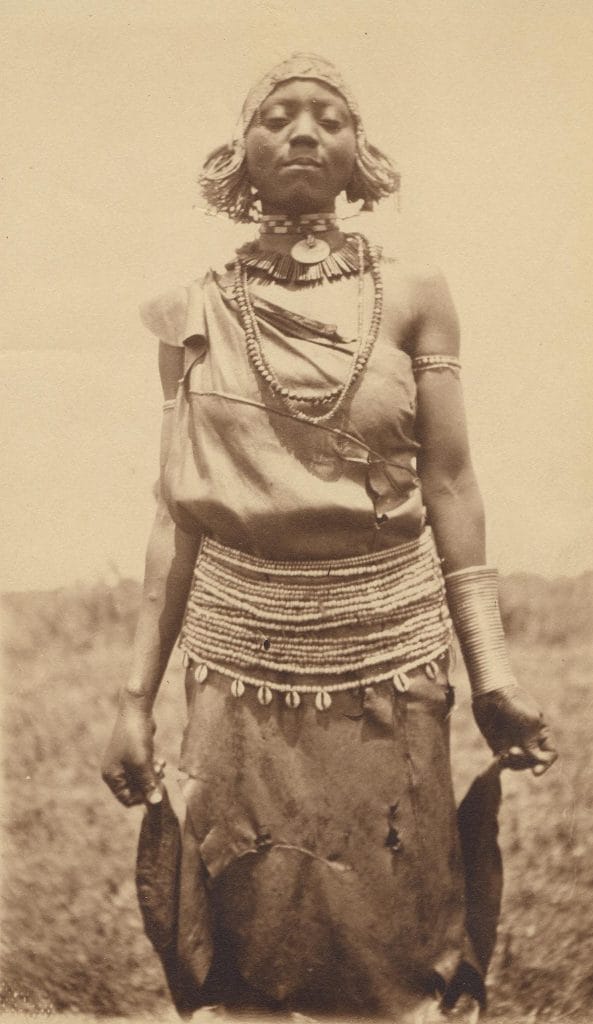
© The Trustees of the British Museum. Shared under a Creative Commons Attribution-NonCommercial-ShareAlike 4.0 International (CC BY-NC-SA 4.0) licence.